
What Is a Stroke?
A Stroke is a serious medical emergency that happens when the blood supply to a part of the brain is interrupted or reduced. When brain cells don’t receive enough oxygen and nutrients, they begin to die within minutes, which can lead to permanent brain damage, disability, or even death if not treated quickly.
There are two main ways this interruption occurs:
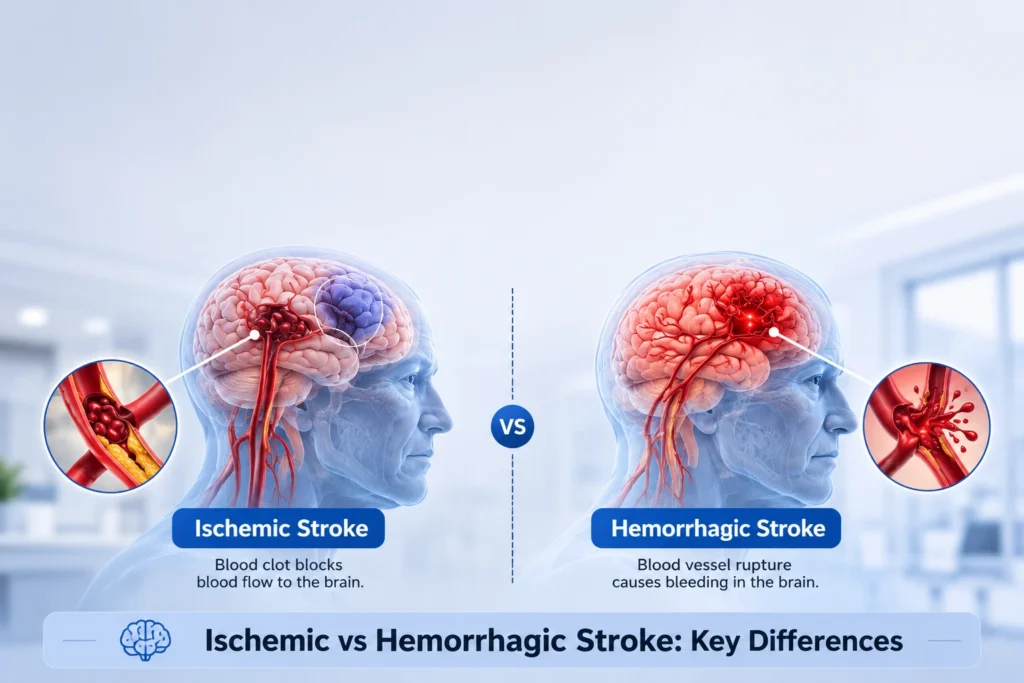
- Blocked blood flow (Ischemic Stroke): A blood clot or fatty deposit blocks an artery supplying the brain.
- Bleeding in the brain (Hemorrhagic Stroke): A weakened blood vessel ruptures and causes bleeding in or around the brain.
Because the brain controls movement, speech, memory, and vital body functions, the effects of a stroke depend on which part of the brain is affected and how quickly treatment begins.
Ready to Begin?
Our centres in Bengaluru (HRBR Layout) and Hyderabad are open Monday to Saturday, 8:30 AM to 6:30 PM.
Ischemic Stroke vs Hemorrhagic Stroke
| Aspect | Ischemic Stroke | Hemorrhagic Stroke |
| Definition | Occurs when blood flow to a part of the brain is blocked, usually by a blood clot | Occurs when a blood vessel in the brain ruptures and bleeds |
| Primary Mechanism | Obstruction prevents oxygen-rich blood from reaching brain tissue | Active bleeding causes direct brain injury and increased pressure |
| Main Cause | Blood clot (thrombus or embolus) | Rupture of a weakened blood vessel |
| Types | • Thrombotic stroke • Embolic stroke | • Intracerebral hemorrhage • Subarachnoid hemorrhage |
| Frequency | Most common (≈ 80–85% of all strokes) | Less common (≈ 10–20% of strokes) |
| Onset of Symptoms | Sudden, may progress over minutes to hours | Very sudden and often severe |
| Typical Early Symptoms | Weakness or numbness on one side, slurred speech, vision problems, confusion | Severe headache, vomiting, loss of consciousness, seizures |
| Headache | Usually mild or absent | Sudden, severe “worst headache of life” |
| Blood Pressure Role | Risk factor but not the direct event | Often the direct cause of vessel rupture |
| Brain Damage Mechanism | Brain cell death due to lack of oxygen (ischemia) | Brain injury due to bleeding, pressure, and swelling |
| Diagnostic Priority | Rule out bleeding before clot treatment | Confirm bleeding and locate source |
| Initial Imaging Test | CT scan or MRI (to rule out hemorrhage) | CT scan (detects bleeding immediately) |
| Primary Emergency Treatment | • Clot-dissolving drugs (tPA) • Mechanical thrombectomy | • Blood pressure control • Surgery or endovascular procedures |
| Use of Blood Thinners | Often used for treatment and prevention | Usually avoided or reversed |
| Surgical Role | Limited to select cases | Often required to stop bleeding or relieve pressure |
| Risk of Rapid Deterioration | Moderate, depends on clot size/location | High due to ongoing bleeding |
| Mortality Risk | Lower with early treatment | Higher, especially in large bleeds |
| Recovery Outlook | Often better with prompt care | More variable; depends on bleed size and location |
| Common Long-Term Effects | Paralysis, speech problems, cognitive deficits | Severe disability, seizures, coma in serious cases |
| Prevention Focus | Control BP, diabetes, cholesterol, heart disease | Strict BP control, aneurysm/AVM management |
Treatment at Plexus for Stroke
At Plexus, Stroke rehabilitation follows a comprehensive, multidisciplinary, and patient-centric approach. Treatment is customized based on the type of stroke, severity of brain injury, and individual recovery goals. By integrating advanced therapies with clinical expertise, Plexus focuses on maximizing functional recovery, independence, and quality of life.
- Aquatic Therapy Aquatic therapy uses the natural buoyancy of water to support weakened muscles and reduce stress on joints. For stroke patients, this allows safer movement, improved balance, and early mobility without the fear of falls. The resistance of water helps strengthen muscles, improve circulation, and enhance coordination while reducing pain and muscle stiffness.
- Physiotherapy Physiotherapy plays a vital role in restoring movement, strength, and balance after a stroke. Therapists focus on improving muscle control, posture, walking ability, and joint flexibility. Targeted exercises help reduce spasticity, prevent muscle contractures, and retrain the brain through repetitive, task-specific movements that promote neuroplasticity.
- Occupational Therapy Occupational therapy helps stroke survivors regain independence in daily activities such as dressing, bathing, eating, and writing. Therapists work on fine motor skills, hand-eye coordination, and adaptive techniques. The goal is to help patients return to everyday life with greater confidence by improving functional ability at home and work.
- Cognitive Therapy Stroke can affect memory, attention, problem-solving, and decision-making. Cognitive therapy focuses on restoring these mental functions through structured exercises and brain-training activities. At Plexus, therapists address attention deficits, memory loss, executive function problems, and behavioral changes to improve mental clarity and daily functioning.
- Speech Therapy Speech therapy is essential for patients experiencing difficulty with speech, language, or communication after a stroke. Therapists work on articulation, voice control, language comprehension, and expression. This therapy also helps patients regain confidence in social interactions and improves overall communication skills.
- Swallowing Therapy (Dysphagia Management) Swallowing difficulties are common after Stroke and can lead to choking or aspiration pneumonia if untreated. Swallowing therapy focuses on strengthening throat muscles, improving coordination, and teaching safe swallowing techniques. Personalized exercises and dietary modifications help patients eat and drink safely and comfortably.
Why Choose Plexus in India
Selecting the right centre can significantly impact recovery outcomes. Plexus distinguishes itself in several ways:
Expertise: Established in 2011, Plexus specialises in neurological and regenerative rehabilitation, having treated hundreds of thousands of patients and earned a strong reputation in complex nerve‑injury care. The team includes specialists in both neurology and neurosurgery, providing a comprehensive spectrum of care under a single roof.
Facilities & Multidisciplinary Team: As India’s first ISO‑certified regenerative rehabilitation and research centre, Plexus features state-of-the-art diagnostic imaging, surgical theatres, and dedicated rehabilitation suites. An interdisciplinary team of neurologists, neurosurgeons, physiotherapists, occupational therapists, pain specialists, and regenerative medicine experts work collaboratively to deliver integrated care.
Patient Journey & Access: From initial consultation through discharge and long-term follow-up, Plexus manages every stage of the recovery process. Services accommodate both domestic and international patients, providing cost-effective treatment without compromising quality. Comprehensive outpatient programs, structured therapy plans, and streamlined communication with medical staff support the overall patient experience.
Stroke Rehabilitation at Plexus: A Path to Recovery and Independence
Stroke recovery is a complex journey that requires timely intervention, expert guidance, and a well-coordinated rehabilitation plan. At Plexus, stroke treatment goes beyond symptom management to focus on restoring movement, communication, cognition, and daily independence. Through an integrated approach, Plexus addresses every aspect of post-stroke recovery.By combining advanced rehabilitation techniques with a multidisciplinary team of specialists, Plexus helps patients regain function, rebuild confidence, and improve their quality of life. Early, personalized, and continuous rehabilitation plays a crucial role in maximizing neurological recovery, and at Plexus, each patient is supported at every step toward a healthier, more independent future.
Ready to Begin?
Our centres in Bengaluru (HRBR Layout) and Hyderabad are open Monday to Saturday, 8:30 AM to 6:30 PM.
Other Disorders Treated at Plexus
At Plexus,expertise extends to offer comprehensive care for a variety of neurological and related conditions. Plexus provide specialized treatments for disorders such as, Brachial Plexus Injury , Spinocerebellar Ataxia, Sensory Processing Disorder (SPD), Cerebral Palsy, Multiple Sclerosis,Parkinson’s disease, Spinal Cord Injury, Motor Neuron Disease, Stroke, Autoimmune Conditions, Orthopedic Conditions, and Sports Injuries. Plexus multidisciplinary approach, incorporating therapies like Cell Therapy, Physiotherapy, Occupational Therapy, Aquatic Therapy, and Speech Therapy, ensures personalized care tailored to each condition, helping patients achieve improved mobility, function, and quality of life.
FAQs
How soon should rehabilitation start after a stroke?
Stroke rehabilitation should begin as early as medically possible, often within days of stabilization. Early therapy helps prevent complications, promotes brain recovery, and significantly improves long-term functional outcomes.
Is stroke recovery possible after months or years?
Yes. While early intervention leads to faster recovery, the brain has the ability to adapt and reorganize (neuroplasticity) even months or years after a stroke. Structured rehabilitation at Plexus can still help improve function and quality of life.
How long does stroke rehabilitation usually take?
Recovery duration varies based on stroke type, severity, age, and overall health. Some patients improve within weeks, while others require long-term rehabilitation over several months. Plexus designs individualized programs tailored to each patient’s progress.
Which therapies are most important after a stroke?
Stroke recovery often requires a combination of therapies. Physiotherapy helps restore movement, occupational therapy improves daily activities, speech and swallowing therapy address communication and feeding difficulties, and cognitive therapy supports memory and thinking skills.
Can stroke rehabilitation help with speech and swallowing problems?
Yes. Speech and swallowing therapy are highly effective in improving communication, voice control, and safe swallowing. Early therapy reduces the risk of aspiration and helps patients regain confidence in eating and speaking.
Is aquatic therapy safe for stroke patients?
Aquatic therapy is safe when supervised by trained professionals. The water provides support, reduces fall risk, and allows stroke patients to move more freely while strengthening muscles and improving balance.
How is treatment personalized at Plexus?
At Plexus, each patient undergoes a detailed evaluation. A multidisciplinary team then creates a customized rehabilitation plan based on neurological condition, functional limitations, recovery goals, and progress over time.
Can rehabilitation reduce the risk of long-term disability after stroke?
Yes. Consistent, goal-oriented rehabilitation significantly reduces long-term disability, improves independence, and enhances overall quality of life after stroke.
About the Author
Dr. Na’eem Sadiq
Medical Director of Plexus
Dr. Na’eem Sadiq is a globally recognized neurologist and neuropsychiatrist, renowned for his contributions to the treatment of complex neurological disorders. He founded Plexus in 2011 with a mission to enhance the quality of life for patients living with neurological conditions.
With over 35 years of clinical experience, Dr. Sadiq is considered a leading expert in the field. His internationally acclaimed research spans key topics such as Demyelinating Polyneuropathy, Multiple Sclerosis, Epilepsy, and Migraine, positioning him at the forefront of neurological care worldwide.