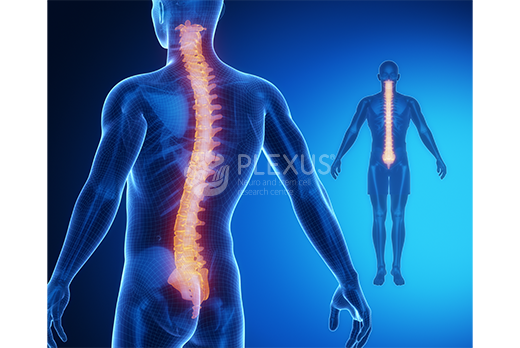

Your spinal cord is a collection of nerves that travels from the bottom of the brain to your back. These nerves allow your brain to give commands to your muscles and cause movements in your arms and legs. They also control your organs, such as your heart, lungs, bowels, and bladder. Hence, your spinal cord is very sensitive to injury. Unlike the other parts of your body, it cannot repair itself if damaged.
A Spinal Cord Injury occurs when there is damage to the spinal cord, either from trauma, loss of blood supply, or compression from a tumor or infection. It can cause weakness, loss of muscle function and, lack of sensation in the body. The injury can also lead to improper bowel and bladder control and loss of sexual function.
Depending on the severity of the injury, there are two types of Spinal Cord Injury:
Patients with a Complete Spinal Cord Injury experience complete paralysis below the level of their injury. They will also have symptoms like a lack of sensation and an inability to feel temperature, pressure, or pain.
Patients with an Incomplete Spinal Cord Injury will experience partial paralysis and loss of sensation as the injury to the spinal cord is less severe. They will also have symptoms like loss of mobility in one or more limbs (depending on which part of the spinal cord was injured), spasticity, neuropathic pain, sexual dysfunction, muscle wasting, and bladder/bowel disorders.
Depending on which section of the spinal cord was injured, there are four levels of Spinal Cord Injury:
01 Cervical Spinal Cord Injury
This is the most severe type of Spinal Cord Injury. It can lead to partial or complete loss of function and associated medical complications. It can also turn out to be fatal.
02 Thoracic Spinal Cord Injury
Such an injury affects the upper chest, abdominal muscles, and mid-back area and can lead to loss of sensation in the legs and genitals, incontinence, and lower back pain.
03 Lumbar Spinal Cord Injury
This injury affects the hips and legs and can lead to varying degrees of loss of function in the lower body.
04 Sacral Spinal Cord Injury
A rare type of Spinal Cord Injury that affects the upper thighs, hips, buttocks, and genital area due to direct injury to the sacral region. Patients will experience some loss of function in the legs and hips but can learn how to walk with physiotherapy.
According to the World Health Organization, every year around 2,50,000 to 5,00,000 people suffer a spinal cord injury (SCI) worldwide. Some possible causes of Spinal Cord Injury include:
Falls
Gunshot wounds
Sports injuries
Surgical complications
Motor vehicle accidents
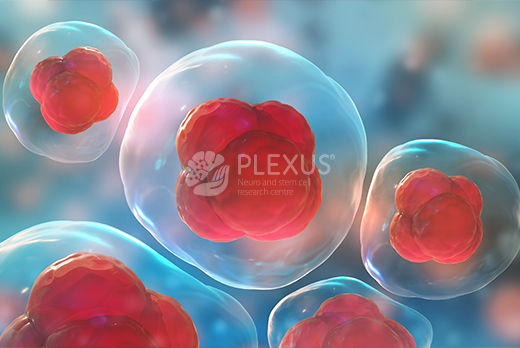
Experiments with Cell Therapy have yielded promising results for the treatment of a Spinal Cord Injury. Autologous Bone Marrow Derived Cells are self-renewing and possess the unique ability to ‘become’ any cell in an organism. Through the suitable application, Autologous Bone Marrow Derived Cells can be turned into neurons to replace the ones lost in a spinal cord injury, thereby restoring neural function to a point where the patient recovers enough mobility and function to live a more independent life.
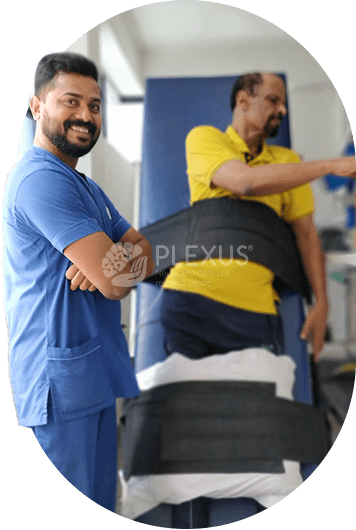
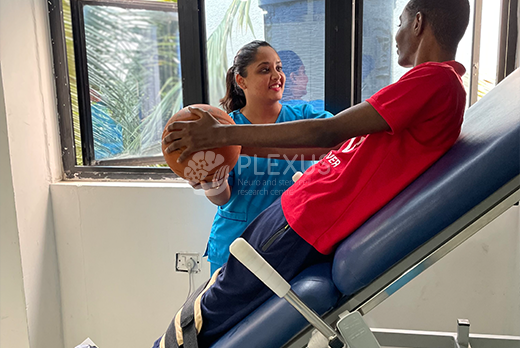
Physiotherapy plays a considerable role in Spinal Cord Injury Rehabilitation. Physiotherapists help to regain function, improve mobility, and prevent complications that may arise years after the initial traumatic injury. Through exercise and assistive devices, patients become stronger and are more flexible overall, with a better sense of balance. They can also develop stamina, posture, and coordination and improve overall physical health.
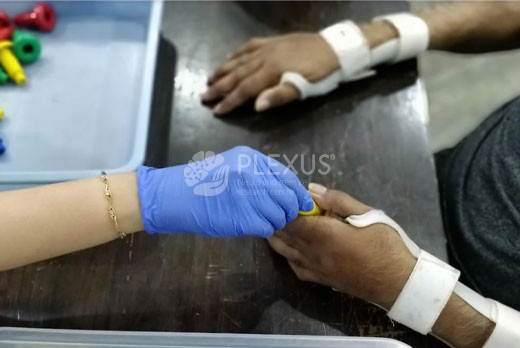
Occupational therapists address social, emotional, and functional aspects of life after Spinal Cord Injury. The goal is to help you gain independence when performing daily activities or adopting a routine at home, in school, out in public, and at work. Occupational therapists assist in improving strength, dexterity, and coordination while performing various day-to-day tasks.
At Plexus, our experiments with Cell Therapy have yielded promising results for treating Spinal Cord Injury. Autologous Bone Marrow Derived Cells are self-renewing and possess the unique ability to ‘become’ any cell in an organism. With Dr Na’eem Sadiq at the helm, our spinal cord specialists turn Autologous Bone Marrow Derived Cells into neurons to replace the ones lost in a spinal cord injury. Thereby, we successfully restore the neural function to a point where you can recover enough mobility and function to lead an independent life.
Our team of neurologists and therapists has extensive experience in providing the best Spinal Cord Injury rehabilitation, comprising Cell Therapy, Physical Therapy, and Occupational Therapy. Recognized globally for our advanced care, we take a holistic approach to rehabilitation that includes a range of exercises for both complete and incomplete Spinal Cord Injuries.
Our spinal cord treatment programs encompass activities like:
Trunk Control and Strength Training
Physical Conditioning and Task Relearning
Spasticity and Orthostatic Hypotension Management
Transitional Patterns Training
Activities of Daily Living (ADL) Training
Mobility Training
Gait Training
Balance Training
Enhanced self-care skills in terms of eating, dressing, bathing, and grooming
Better control over and management of pain and spasticity
Improved mobility independently or with the help of walkers or wheelchairs
Improved bowel and bladder sensation and/or control.
Improved flexibility, strength, and endurance.
Improved control over work-related or vocational skills
Psychological support for emotional needs and developing a healthy mindset
Educational resources for the family so that they can optimally support the patient
Rama Tirtha (name changed)
“I am Rama Tirtha, a quadraplegic, cervical (c5-c6) injury patient who could not move without a walker. I had to drag my legs and my fingers were completely closed and tight before coming to Plexus Neuro and Center.
I heard about Plexus from a friend who had come down from Mysore after meeting Dr Naeem Sadiq. Dr Na’eem recommended Cell Therapy and rehabilitation for two months. He had promised that he would help me increase my mobility. Now I can walk, my fingers have opened up, and even my grip is better.
Plexus is the kind of place where you do not feel like a patient. It has a homely atmosphere and all your problems are dealt with patiently. Dr. Naeem and his team put in a lot of effort in treating their patients. They conduct weekly reviews to keep track of their improvement and set tasks for themselves to help improve the patients even further.
So far, I have opted for treatment for four months, including rehabilitation comprising Physiotherapy and Occupational Therapy. I received Cell Therapy in the first month and my improvement has been commendable. My balance and posture has completely improved and the fear of falling down has disappeared. Now I can walk for a longer period. All of these achievements are due to the Plexus rehabilitation team who sweat it out with their patients to increase independence, boost energy, and renew confidence. I am so thankful to my team - Kanishka, Subhadeep, Sailo, Kasturee and Deb for helping me achieve the impossible.

I would recommend Plexus Neuro and Cell Research Center to everyone as I believe it is the best in India. I would like to thank Dr Na’eem Sadiq Sir and his team for giving me a new lease on life and a better tomorrow.”

Ayesha (name changed)
"I came from Maldives to get treated for my cervical spinal cord injury. I was completely immobile. Even sitting on a wheelchair was impossible for me and I would only prefer lying down at all times. I took cells and rehab for three months and now I can stand with support! I can easily sit for hours together without getting tired and can even use my hands. The entire team at Plexus is simply amazing. Thank you everyone!"
Yes, you will definitely be able to walk based on your clinical state. The lower your injury and the more sensation you have after your injury, the greater your chances are of regaining mobility.
Yes, depending on the level of injury and it may take some time.
Our Regenerative Rehabilitation program consists of Cell Therapy, Cell Nutritive Therapy, various oral and intravenous medications, and a holistic rehabilitation program consisting of Physiotherapy and Occupational Therapy.