

What Is Multiple Sclerosis (MS)?
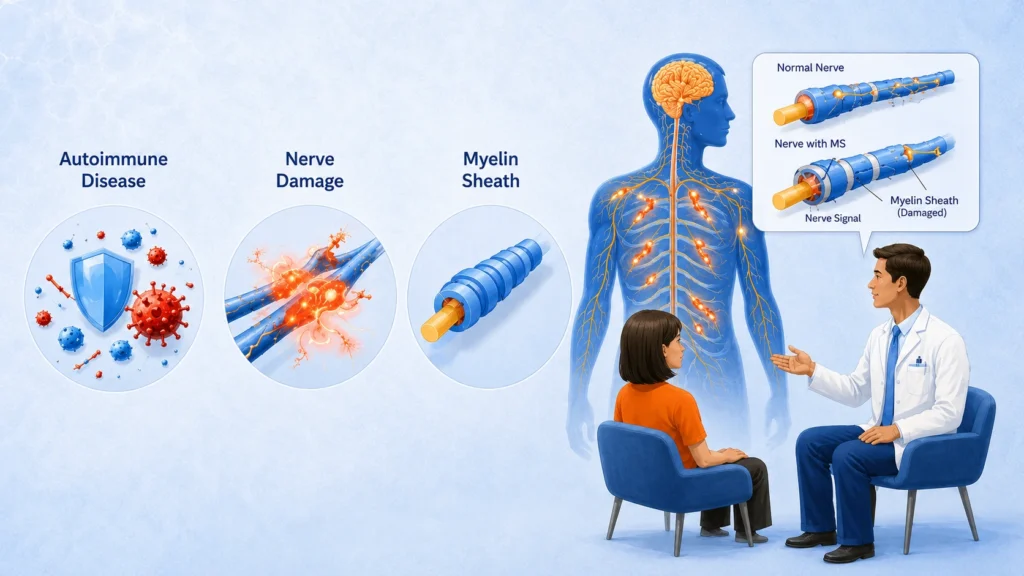
Multiple Sclerosis is an autoimmune neurological condition in which the body’s immune system attacks the protective myelin sheath surrounding nerve fibers in the brain and spinal cord. Damage to this insulation slows or blocks nerve signals, resulting in a wide range of physical, sensory, and cognitive symptoms. Multiple Sclerosis is a lifelong condition with varying degrees of severity and progression, requiring early diagnosis and long-term medical and rehabilitative care.
Ready to Begin?
Our centres in Bengaluru (HRBR Layout) and Hyderabad are open Monday to Saturday, 8:30 AM to 6:30 PM.
Causes of Multiple Sclerosis
| Cause | Explanation |
| Genetic Factors | Genetics play a significant role in predisposing individuals to MS. People with a family history of Multiple Sclerosis have a higher risk of developing the disease, suggesting that certain genes related to immune system regulation may increase susceptibility. Although no single gene causes MS, variations in genes such as the HLA-DRB1 gene can influence immune response and increase the risk. |
| Immune System Dysfunction | MS is fundamentally an autoimmune disorder. In affected individuals, the immune system mistakenly targets myelin, the protective layer around nerve fibers, leading to inflammation, nerve damage, and impaired signal transmission. This abnormal immune response is influenced by both genetic and environmental factors |
| Environmental Factors | Environmental influences are significant contributors to Multiple Sclerosis development. Low vitamin D levels, due to limited sunlight exposure, have been associated with increased risk. Geographic regions farther from the equator tend to show higher Multiple Sclerosis prevalence, suggesting that sunlight and vitamin D play a protective role. Other factors, such as exposure to certain viruses, may also trigger the autoimmune response. |
| Viral and Infectious Triggers | Certain viral infections, especially Epstein-Barr virus (EBV), are strongly linked to MS. Infection with EBV during adolescence or adulthood may trigger an abnormal immune response that later attacks the nervous system. Other viruses, including human herpesvirus 6 (HHV-6), may also contribute, though evidence is less definitive. |
| Lifestyle Factors | Lifestyle and health behaviors may influence Multiple Sclerosis risk. Smoking, obesity, and high-stress levels have been linked to a higher likelihood of developing MS. Smoking, for instance, can worsen immune system dysfunction and increase inflammation in the CNS, accelerating disease progression. |
| Hormonal and Gender Factors | MS is more common in women than men, suggesting that hormonal factors may play a role. Fluctuations in estrogen and progesterone levels could influence immune system behavior, potentially affecting susceptibility and severity. |
Symptoms of Multiple Sclerosis
- Fatigue
Fatigue is one of the most common and debilitating symptoms of MS. Unlike normal tiredness, MS-related fatigue can occur suddenly and be overwhelming, affecting both physical and mental performance. Patients may feel drained even after minimal activity or rest. The exact cause is multifactorial, including the energy cost of nerve signal repair due to demyelination, immune system activity, and secondary effects like poor sleep, muscle weakness, or depression. This fatigue can significantly interfere with daily activities, work, and social life.
- Numbness and Tingling
Many people with Multiple Sclerosis experience numbness, tingling, or a “pins and needles” sensation, often in the face, arms, legs, or fingers. This symptom arises because demyelination disrupts normal nerve signaling, causing abnormal sensations or a lack of sensation in the affected areas. These sensory disturbances can be intermittent or persistent and sometimes precede other neurological symptoms, making them an early warning sign of MS.
- Muscle Weakness and Spasms
MS can lead to muscle weakness and spasticity, which is involuntary stiffness or spasms of muscles. Weakness usually appears in the arms or legs and can make simple activities like walking, lifting objects, or climbing stairs difficult. Spasticity occurs because damaged nerves miscommunicate signals to muscles, leading to continuous contraction or sudden involuntary movements. Severe spasticity can interfere with mobility and posture, requiring therapies like physiotherapy or medications for management.
- Difficulty with Coordination and Balance (Ataxia)
Damage to the nerves controlling movement and coordination can result in ataxia, which is a lack of muscle control affecting balance and precise movements. People with Multiple Sclerosis may experience unsteady walking, difficulty with fine motor tasks like writing or buttoning clothes, and a higher risk of falls. Ataxia occurs because demyelination interrupts signals between the brain, spinal cord, and muscles, making smooth and coordinated movements challenging.
- Vision Problems
Vision disturbances are common in Multiple Sclerosis due to inflammation of the optic nerve (optic neuritis) or lesions along visual pathways in the brain. Patients may experience blurred vision, double vision (diplopia), pain with eye movement, or temporary loss of vision in one eye. These symptoms often develop suddenly and may improve over time, though repeated attacks can lead to lasting vision impairment. Visual problems are often among the earliest signs of MS.
- Cognitive Impairment
MS can affect cognition, including memory, attention, problem-solving, and information processing speed. While cognitive symptoms are often mild, they can significantly impact work, school, and daily functioning. The cause is primarily demyelination and nerve damage in brain regions responsible for cognitive processing. Stress, fatigue, and depression associated with Multiple Sclerosis can further worsen cognitive performance.
- Speech and Swallowing Difficulties
When Multiple Sclerosis affects nerves controlling speech and swallowing, patients may experience slurred speech (dysarthria) or difficulty swallowing (dysphagia). These issues occur due to lesions in the brainstem or cranial nerves, which interfere with precise muscle control. Speech and swallowing difficulties can increase the risk of choking, aspiration, and social embarrassment, making therapy and adaptive strategies important.
- Pain and Sensory Changes
MS can cause chronic neuropathic pain, often described as burning, stabbing, or electric-shock-like sensations. Some patients also experience heightened sensitivity to touch (allodynia) or abnormal sensations like itching without stimulus. This pain arises because demyelination leads to improper nerve signaling, sending false pain signals to the brain. Pain can be intermittent or constant and significantly reduce quality of life.
- Bladder and Bowel Dysfunction
Nerve damage in Multiple Sclerosis can disrupt signals between the brain and bladder or bowel, causing problems such as urgency, frequency, incontinence, or constipation. These issues are common and may occur at any stage of the disease. Bladder dysfunction is particularly prevalent, leading to social discomfort and increased risk of infections, while bowel problems can affect nutrition and daily routines.
- Emotional and Mood Changes
Emotional disturbances, including depression, anxiety, irritability, and mood swings, are frequent in MS. These changes may result from neurochemical imbalances caused by nerve damage, the psychological burden of living with a chronic illness, or social isolation. Depression can worsen fatigue and cognitive symptoms, creating a cycle that significantly affects mental health and overall well-being.
Role of Inflammation and Nerve Damage in Multiple Sclerosis
1. Immune System Activation
In Multiple Sclerosis (MS), the immune system becomes abnormally activated and mistakenly identifies components of the central nervous system as foreign. Immune cells such as T-cells and B-cells enter the brain and spinal cord, triggering an inflammatory response that initiates tissue damage.
2. Breakdown of the Blood–Brain Barrier
Inflammation causes disruption of the blood–brain barrier, a protective layer that normally prevents harmful substances from entering the central nervous system. Once this barrier is compromised, immune cells and inflammatory chemicals gain access to neural tissue, worsening inflammation and damage.
3. Inflammatory Attack on Myelin
The primary target of inflammation in Multiple Sclerosis is myelin, the protective sheath surrounding nerve fibers. Inflammatory mediators damage and strip away myelin, a process known as demyelination, which interferes with efficient nerve signal transmission.
4. Formation of Active Inflammatory Lesions
Areas of intense inflammation form active lesions or plaques within the brain and spinal cord. These lesions represent sites of ongoing immune activity and are often associated with acute relapses or worsening neurological symptoms.
5. Slowed or Blocked Nerve Signal Transmission
Myelin is essential for rapid electrical communication along nerves. When inflammation damages myelin, nerve impulses become slower or completely blocked. This leads to symptoms such as muscle weakness, numbness, coordination problems, fatigue, and vision impairment.
6. Secondary Axonal (Nerve Fiber) Damage
Prolonged inflammation does not remain limited to myelin. Over time, it damages the underlying axon, the nerve fiber itself. Axonal injury results in permanent loss of nerve function and contributes significantly to long-term disability in MS.
How Multiple Sclerosis Affects the Central Nervous System
1. Involvement of the Central Nervous System
Multiple Sclerosis (MS) primarily affects the central nervous system (CNS), which includes the brain, spinal cord, and optic nerves. These structures control movement, sensation, vision, cognition, and bodily functions. Damage within the CNS disrupts communication between the brain and the rest of the body.
2. Immune-Mediated Damage to CNS Tissue
In MS, immune cells mistakenly attack CNS components, particularly myelin. These immune cells cross the blood–brain barrier and trigger inflammation within the brain and spinal cord, leading to tissue injury and impaired neurological function.
3. Demyelination of Nerve Fibers
The protective myelin sheath around nerve fibers in the CNS is damaged through inflammatory processes. Demyelination reduces the speed and efficiency of electrical signal transmission, resulting in delayed or faulty nerve communication.
4. Formation of CNS Lesions
Areas of myelin loss heal with scar tissue known as sclerosis. These lesions form in different parts of the brain and spinal cord and are a hallmark of MS. The location and size of lesions determine the type and severity of symptoms experienced.
5. Effects on the Brain
When Multiple Sclerosis affects the brain, it can lead to:
- Cognitive difficulties such as memory and attention problems
- Emotional changes including depression or mood swings
- Impaired coordination and balance
- Fatigue due to inefficient neural signaling
Brain involvement may also cause brain volume loss over time.
6. Effects on the Spinal Cord
Lesions in the spinal cord interfere with signals traveling between the brain and body. This can cause:
- Muscle weakness or paralysis
- Stiffness and spasticity
- Numbness or altered sensation
- Bladder and bowel dysfunction
Spinal cord damage often has a significant impact on mobility and independence.
7. Effects on the Optic Nerves
MS commonly affects the optic nerves, leading to optic neuritis. This results in:
- Blurred or double vision
- Pain during eye movement
- Partial or complete vision loss
- Reduced color perception
Visual symptoms are often among the earliest signs of MS.
What is ICD-10 Code for Multiple Sclerosis
The internationally accepted ICD-10 code for Multiple Sclerosis is G35.
This code is assigned when a patient is clinically diagnosed with Multiple Sclerosis based on neurological findings, imaging evidence, and supportive laboratory results.
The ICD-10 classification system, developed by the World Health Organization (WHO), standardizes disease identification across hospitals, clinics, insurance providers, and research institutions. In the context of MS, the G35 code encompasses all recognized forms of the disease, including relapsing and progressive variants, unless further subclassification is required for clinical documentation.
Accurate use of the ICD-10 code G35 ensures that Multiple Sclerosis is consistently recognized as a chronic neurological disorder requiring long-term medical and rehabilitative management.
Why ICD-10 Coding Is Important in Diagnosis and Treatment
1. Standardized Disease Identification
ICD-10 coding provides a universally accepted framework for identifying Multiple Sclerosis. This standardization eliminates variations in terminology and ensures that Multiple Sclerosis is recognized uniformly by neurologists, rehabilitation specialists, hospitals, and healthcare systems worldwide.
2. Diagnostic Accuracy and Clinical Validation
Assigning the correct ICD-10 code confirms that the diagnosis of Multiple Sclerosis meets established medical and neurological criteria. It reflects the completion of appropriate diagnostic evaluations, such as MRI imaging, cerebrospinal fluid analysis, and neurological examinations.
3. Foundation for Treatment Planning
The ICD-10 code serves as the foundation for creating individualized treatment plans. It supports decisions related to disease-modifying therapies, symptom-specific medications, and neurorehabilitation programs such as physiotherapy, occupational therapy, and cognitive rehabilitation.
4. Insurance Authorization and Reimbursement
Health insurance providers require accurate ICD-10 coding to approve consultations, investigations, therapies, and long-term care services. The G35 code helps ensure reimbursement for ongoing MS-related treatments and prevents delays or denials in care.
5. Multidisciplinary Care Coordination
Multiple Sclerosis requires input from neurologists, physiotherapists, occupational therapists, speech therapists, psychologists, and rehabilitation physicians. ICD-10 coding enables seamless communication across these disciplines by clearly identifying the primary medical condition.
6. Monitoring Disease Course and Outcomes
Consistent use of ICD-10 coding allows healthcare providers to track disease progression, relapse frequency, functional decline, and response to treatment over time. This longitudinal documentation is essential for adjusting treatment strategies and rehabilitation goals.
7. Clinical Research and Epidemiological Tracking
ICD-10 codes enable accurate data collection for Multiple Sclerosis research, clinical trials, and population studies. Researchers rely on standardized coding to analyze disease prevalence, progression patterns, and treatment outcomes across large patient populations.
8. Healthcare Resource Planning
Hospitals and public health systems use ICD-10 data to assess disease burden, allocate neurological and rehabilitation resources, and develop specialized Multiple Sclerosis care programs. This supports better healthcare infrastructure planning.
Types of Multiple Sclerosis
| Type of Multiple Sclerosis | Medical Description | Disease Course & Progression | Common Symptoms | Clinical Notes |
| Relapsing-Remitting Multiple Sclerosis (RRMS) | Characterized by immune-mediated inflammatory attacks on the CNS followed by periods of partial or complete recovery | Clearly defined relapses (flare-ups) with remission phases; no continuous progression between relapses | Vision problems, fatigue, numbness, muscle weakness, coordination issues | Most common form; early diagnosis and treatment can significantly slow progression |
| Secondary Progressive Multiple Sclerosis (SPMS) | Develops from RRMS when inflammation leads to gradual neurodegeneration | Progressive neurological decline with or without superimposed relapses | Worsening mobility, spasticity, cognitive decline, fatigue | Represents transition from inflammatory to neurodegenerative phase |
| Primary Progressive Multiple Sclerosis (PPMS) | Neurodegeneration begins from disease onset with minimal inflammatory activity | Continuous worsening without distinct relapses or remissions | Progressive weakness, balance issues, gait disturbances | Less common; often diagnosed later due to subtle early symptoms |
| Progressive-Relapsing Multiple Sclerosis (PRMS) | Progressive disease course with acute inflammatory relapses | Steady progression with superimposed relapses | Increasing disability with occasional symptom flare-ups | Rare subtype; considered part of the progressive spectrum |
| Clinically Isolated Syndrome (CIS) | First neurological episode suggestive of demyelination | May remain isolated or progress to definite MS | Optic neuritis, sensory loss, motor symptoms | Early intervention may delay or prevent progression to MS |
How Multiple Sclerosis Is Diagnosed
Multiple Sclerosis (MS) is diagnosed through a combination of clinical evaluation, imaging studies, and laboratory tests. Physicians begin with a detailed review of the patient’s medical history and neurological examination, assessing symptoms such as vision changes, numbness, muscle weakness, coordination problems, and fatigue. Magnetic Resonance Imaging (MRI) is the most important tool, detecting demyelinating lesions in the brain and spinal cord. A lumbar puncture may be performed to analyze cerebrospinal fluid for immune markers, while evoked potential tests measure nerve signal conduction to detect early or silent lesions. Blood tests are also conducted to rule out other conditions that mimic MS.
Why Early Medical Understanding of Multiple Sclerosis Matters
Early medical understanding of Multiple Sclerosis (MS) is crucial for slowing disease progression and preserving neurological function. Recognizing symptoms and initiating evaluation at an early stage allows timely use of disease-modifying therapies, which reduce inflammation, prevent relapses, and protect nerve fibers from permanent damage. Early intervention also enables rehabilitation strategies, including physiotherapy, occupational therapy, and cognitive therapy, to maintain mobility, daily functioning, and quality of life. Additionally, prompt education empowers patients and families to make informed decisions about lifestyle adjustments, long-term care planning, and symptom management. Overall, early understanding and intervention in Multiple Sclerosis significantly improve long-term outcomes and reduce the risk of severe disability.
Treatment for Multiple Sclerosis at Plexus
Aquatic Therapy
Aquatic therapy, or hydrotherapy, uses the natural properties of water, buoyancy, resistance, and warmth, to support gentle movement and exercise. This therapy reduces joint stress, decreases muscle spasticity, improves balance, and enhances coordination. Patients perform water-based exercises such as walking, stretching, and resistance activities under the guidance of trained therapists. The supportive environment of water allows patients with significant weakness or fatigue to exercise safely, resulting in improved strength, mobility, and overall physical function.
Physiotherapy
Physiotherapy at Plexus focuses on strengthening muscles, improving flexibility, and enhancing coordination. It addresses common MS-related challenges such as muscle weakness, stiffness, gait disturbances, and balance issues. The therapy plan may include targeted exercises, stretching routines, posture correction, and gait retraining, often combined with assistive devices. Physiotherapy not only helps restore mobility but also prevents secondary complications like joint contractures, reducing long-term disability and improving day-to-day functional independence.
Occupational Therapy
Occupational therapy helps Multiple Sclerosis patients regain independence in daily life and work-related activities. Therapists assess the patient’s environment, motor skills, and energy levels to design personalized interventions. Patients learn strategies to conserve energy, improve fine motor skills, and adapt tasks or surroundings for safer and easier performance. By providing practical solutions and adaptive tools, occupational therapy enhances self-care, productivity, and overall quality of life, reducing reliance on caregivers.
Cognitive Therapy
Cognitive therapy addresses the mental and cognitive challenges that can occur in MS, such as memory loss, difficulty concentrating, slow information processing, and impaired executive function. Therapy may include structured brain exercises, computer-based cognitive training, and practical strategies to compensate for cognitive deficits. The goal is to enhance mental clarity, reduce cognitive fatigue, and improve the patient’s ability to manage daily tasks, professional responsibilities, and social interactions.
Speech and Language Therapy
MS can impact speech, voice, and swallowing due to neurological involvement. Speech and language therapy aims to improve articulation, clarity, breath control, and safe swallowing techniques. Patients may engage in voice exercises, oral motor activities, and, if needed, use assistive communication devices. This therapy enhances communication, reduces the risk of aspiration, and supports social and emotional well-being.
Cell Therapy
Cell therapy is an advanced regenerative approach offered at Plexus to support nerve repair and functional recovery in MS. Administered under strict medical supervision, cell therapy aims to promote neural regeneration, reduce inflammation, and complement conventional rehabilitation. While not a standalone cure, it may enhance outcomes from physiotherapy, occupational therapy, and cognitive therapy, potentially improving mobility, cognitive function, and quality of life.
Why Choose Plexus in India
Selecting the right centre can make a world of a difference to recovery outcomes. Here’s why Plexus stands out:
- Expertise: Since 2011, Plexus has specialised in neurological and regenerative rehabilitation, treating hundreds of thousands of patients and building a strong reputation in complex nerve‑injury care. Plexus specialists are experienced in both neurology and neuro‑surgery, offering the full spectrum of care under one roof.
- Facilities & Multidisciplinary Team: Plexus is India’s first ISO‑certified regenerative rehabilitation & research centre, equipped with state‑of‑the‑art diagnostic imaging, surgical theatres and dedicated rehabilitation suites. Plexus interdisciplinary team includes neurologists, neurosurgeons, physiotherapists, occupational therapists, pain specialists and regenerative medicine experts all collaborating to deliver integrated care.
- Patient Journey & Access: From first consultation to discharge and long‑term follow‑up, Plexus guides patients through every stage of recovery. Plexus supports both Indian and international patients, offering cost‑effective care without compromising quality. Comfortable outpatient programs, therapy and treatment planning, and accessible communication with Plexus doctors are part of Plexus commitment.
Ready to Begin?
Our centres in Bengaluru (HRBR Layout) and Hyderabad are open Monday to Saturday, 8:30 AM to 6:30 PM.
Other Disorders Treated at Plexus
At Plexus,expertise extends to offer comprehensive care for a variety of neurological and related conditions. Plexus provide specialized treatments for disorders such as, Brachial Plexus Injury , Spinocerebellar Ataxia, Sensory Processing Disorder (SPD), Cerebral Palsy, Multiple Sclerosis,Parkinson’s disease, Spinal Cord Injury, Motor Neuron Disease, Stroke, Autoimmune Conditions, Orthopedic Conditions, and Sports Injuries. Plexus multidisciplinary approach, incorporating therapies like Cell Therapy, Physiotherapy, Occupational Therapy, Aquatic Therapy, and Speech Therapy, ensures personalized care tailored to each condition, helping patients achieve improved mobility, function, and quality of life.
FAQs
What is Multiple Sclerosis (MS)?
Multiple Sclerosis is a chronic autoimmune neurological disorder in which the immune system attacks the protective myelin sheath of nerve fibers in the brain and spinal cord, disrupting communication between the brain and the body.
What causes Multiple Sclerosis?
The exact cause of Multiple Sclerosis is unknown, but it is believed to result from a combination of genetic susceptibility, immune system dysfunction, and environmental factors such as infections and vitamin D deficiency.
What are the early symptoms of Multiple Sclerosis?
Early symptoms of Multiple Sclerosis may include blurred or double vision, numbness or tingling in the limbs, muscle weakness, fatigue, balance problems, and difficulty concentrating.
What is the ICD-10 code for Multiple Sclerosis?
The ICD-10 code for Multiple Sclerosis is G35, which is used for medical documentation, insurance claims, and treatment planning.
What are the types of Multiple Sclerosis?
The main types include Relapsing-Remitting Multiple Sclerosis (RRMS), Secondary Progressive Multiple Sclerosis (SPMS), Primary Progressive Multiple Sclerosis (PPMS), Progressive-Relapsing Multiple Sclerosis (PRMS), and Clinically Isolated Syndrome (CIS).
About the Author
Dr. Na’eem Sadiq
Medical Director of Plexus
Dr. Na’eem Sadiq is a globally recognized neurologist and neuropsychiatrist, renowned for his contributions to the treatment of complex neurological disorders. He founded Plexus in 2011 with a mission to enhance the quality of life for patients living with neurological conditions.
With over 35 years of clinical experience, Dr. Sadiq is considered a leading expert in the field. His internationally acclaimed research spans key topics such as Demyelinating Polyneuropathy, Multiple Sclerosis, Epilepsy, and Migraine, positioning him at the forefront of neurological care worldwide.