
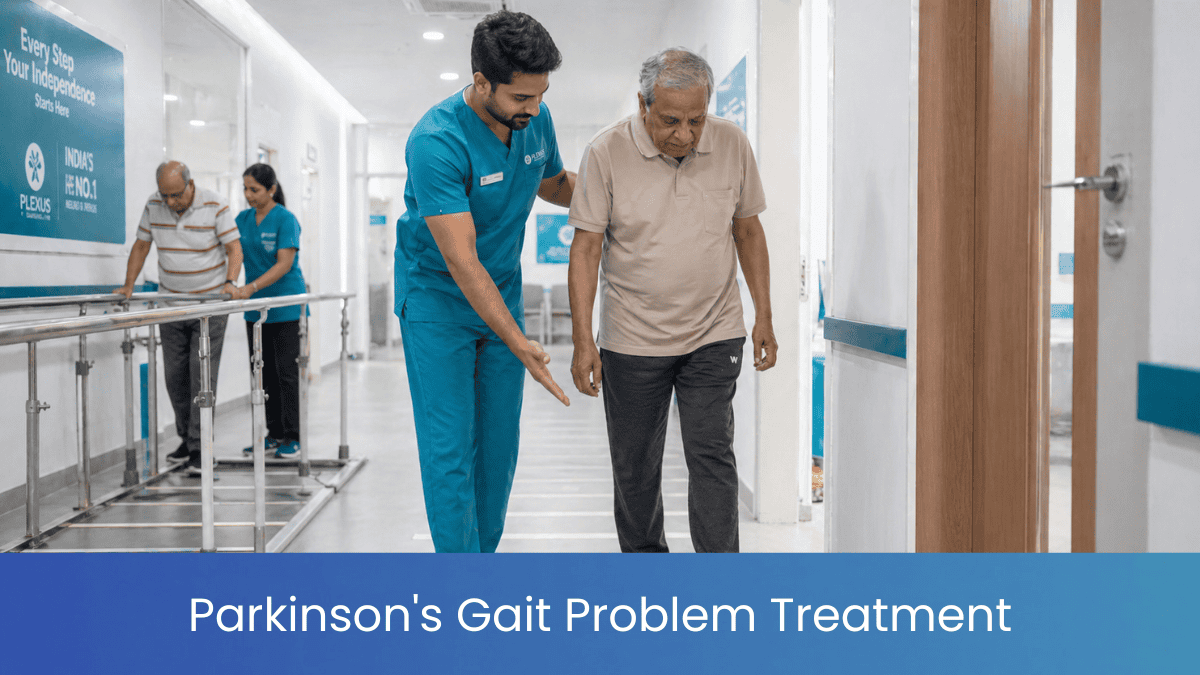
The Walk That Changes Everything
For someone living with Parkinson’s disease, the change in how they walk is rarely sudden. It begins with steps that feel heavier. A shuffle that wasn’t there before. A hesitation at a doorway that becomes a freeze. The forward lean that makes every step feel like the start of a fall.
Gait problems in Parkinson’s disease are among the most functionally limiting and fall-risk-sensitive aspects of the condition. They arise from the progressive degeneration of dopaminergic neurons that disrupts the brain’s control over postural stability, step initiation, and movement rhythm, and they do not respond adequately to medication alone.
Parkinson’s gait problem treatment at Plexus combines autologous mesenchymal cell therapy with specialist neuro-Physiotherapy and Aquatic Therapy to address the neurological basis of gait deterioration and restore the movement fluency that Parkinson’s disease progressively erodes.
Founded by Dr. Na’eem Sadiq, Plexus brings over 35 years of neurological expertise and has treated more than 500,000 patients. As India’s first ISO-certified regenerative rehabilitation and research centre, it delivers the most clinically comprehensive gait treatment available in India for Parkinson’s disease.
Why Does Parkinson’s Disease Cause Gait Problems?
The dopaminergic degeneration of the substantia nigra disrupts the basal ganglia’s role in regulating stride length, step timing, and postural control. This produces a distinct and clinically recognised cluster of gait and movement symptoms, each of which Plexus’s programme is structured to address:
- Parkinson’s shuffling walk treatment is needed when stride length shortens significantly, producing the characteristic small-stepped, shuffling gait pattern that increases fall risk and reduces walking speed
- Parkinson’s freezing episodes treatment addresses the sudden, involuntary interruption of gait, most commonly at doorways, when turning, or when navigating confined spaces, that can cause falls and severely limits independent mobility.
- Parkinson’s stooped posture treatment is required when the trunk flexes forward involuntarily, shifting the centre of gravity and creating the forward-leaning posture that characterises advanced Parkinson’s gait.
- Parkinson’s balance disorder treatment addresses the impaired postural righting reflexes that make recovering from unexpected weight shifts increasingly difficult
- Parkinson’s muscle stiffness physiotherapy targets the rigidity in the legs, hips, and trunk that reduces walking fluency and increases the effort required for each step
- Parkinson’s leg stiffness treatment focuses on the lower limb rigidity that contributes to the reduced knee and ankle movement seen in Parkinson’s gait
- Parkinson’s slow movement physiotherapy addresses the bradykinesia that reduces walking speed, impairs step initiation, and makes Parkinson’s walking difficulty increasingly pronounced
- Parkinson’s weak muscles treatment addresses the muscle deconditioning that compounds neurological gait impairment over time
- Parkinson’s body pain treatment addresses the musculoskeletal discomfort arising from rigidity, postural asymmetry, and abnormal movement patterns that accumulate as gait deteriorates
How Plexus’s Parkinson’s Gait Problem Treatment Works at the Neurological Level
Cell therapy at Plexus supports the brain circuitry governing gait and postural control through the following mechanisms:
- Neuroprotection of dopaminergic neurons in the substantia nigra, directly influencing the pace at which stride length, step initiation, and postural stability decline
- Neuroinflammation reduction across the motor networks governing gait coordination, creating a more stable environment for neuronal survival
- Release of BDNF and GDNF neurotrophic factors sustaining neuronal survival and synaptic function across the basal ganglia and motor circuits that regulate walking rhythm and posture
- A stronger neurological substrate for neuro-Physiotherapy and Aquatic Therapy, producing more durable gait rehabilitation gains than physiotherapy alone can achieve against ongoing neurodegeneration
What Does Parkinson’s Gait Problem Treatment at Plexus Involve?
Clinical Assessment
Before treatment begins, the Plexus team evaluates:
- Gait characteristics including stride length, cadence, step symmetry, and freezing frequency
- Postural alignment and stooped posture severity
- Postural righting reflexes and balance function under static and dynamic conditions
- Leg rigidity and muscle strength across lower limb and trunk muscle groups
- Fall history, fall risk profile, and home environment factors
Autologous Cell Therapy Procedure
- Mesenchymal cells are harvested from the patient’s bone marrow under local anaesthesia, processed in Plexus’s ISO-certified laboratory, and administered into the central nervous system. The procedure is minimally invasive, requires no general anaesthesia, and no extended hospitalisation.
Integrated Gait Rehabilitation Programme
Following cell therapy, patients begin a structured rehabilitation programme incorporating:
- Neuro-Physiotherapy targeting Parkinson’s shuffling walk treatment through stride amplitude training, cueing strategies, and gait retraining; Parkinson’s freezing episodes treatment through anti-freezing techniques and step initiation work; and Parkinson’s stooped posture treatment through trunk extension and postural alignment exercises
- Aquatic Therapy at India’s first hospital-integrated pool, providing a low-risk environment for balance retraining, Parkinson’s weak muscles treatment, and Parkinson’s leg stiffness treatment through water resistance-based strengthening
- Occupational Therapy addressing the practical impact of gait problems on daily navigation, stair climbing, and home safety
- Parkinson’s Disease Rehabilitation coordinating all disciplines within a single integrated clinical structure
Improvements Patients Have Experienced
Patients who have completed Parkinson’s gait problem treatment at Plexus have reported:
- Longer, more confident strides with less shuffling during everyday walking
- Fewer freezing episodes particularly at doorways and during turning
- Improved postural alignment with reduced forward trunk lean
- Greater balance stability and reduced fall frequency
- Reduced leg stiffness and more fluid lower limb movement
- Less body pain and musculoskeletal discomfort associated with abnormal gait patterns
- Increased walking distance and confidence in outdoor and community settings
How Parkinson’s Gait Problem Treatment at Plexus Compares
| Factor | Conventional Management | Plexus Gait Problem Treatment |
| Neurological Intervention | Not available | ISO-certified autologous cell therapy |
| Gait-Specific Physiotherapy | Variable | Parkinson’s-specific neuro-Physiotherapy |
| Aquatic Therapy | Not hospital-integrated | India’s first hospital-integrated pool |
| Freezing Episodes Treatment | Limited | Dedicated anti-freezing protocol |
| Posture Treatment | Rarely structured | Integrated postural alignment programme |
| Disease Modification | Not available | Aims to slow gait-relevant neurodegeneration |
Who Should Consider Parkinson’s Gait Problem Treatment at Plexus?
This programme is appropriate for patients who:
- Have a confirmed Parkinson’s disease diagnosis in whom gait problems, freezing, shuffling, stooped posture, or fall risk is affecting mobility and daily independence
- Find that medication is providing incomplete gait control or that freezing and postural instability remain prominent
- Are seeking Parkinson’s muscle stiffness physiotherapy, Parkinson’s balance disorder treatment, or Parkinson’s slow movement physiotherapy within an integrated neurobiological programme
- Are medically stable and able to engage consistently with structured gait and balance rehabilitation
Why Plexus for Parkinson’s Gait Problem Treatment
- India’s only ISO-certified regenerative rehabilitation and research centre delivering autologous cell therapy alongside integrated gait and balance rehabilitation for Parkinson’s disease
- India’s first hospital-integrated Aquatic Therapy pool for low-risk balance training and lower limb strengthening
- Parkinson’s-specific neuro-Physiotherapy delivered by specialists with condition-specific training in gait retraining, freezing management, and postural correction
- Over 70 national and international awards for clinical excellence in neurological and regenerative rehabilitation
- Led by Dr. Na’eem Sadiq with over 35 years of neurological expertise and more than 500,000 patients treated
Other Neurological Conditions Treated at Plexus
Specialist programmes are available for Multiple Sclerosis, Spinocerebellar Ataxia, Motor Neuron Disease, Spinal Cord Injury, Stroke, Cerebral Palsy, Brachial Plexus Injury, Autoimmune Neurological Conditions, and Sports Injuries.
Source Transparency and Editorial Accountability
- Bloem, B.R., Okun, M.S., Klein, C. (2021). Parkinson’s disease. The Lancet, 397(10291), 2284-2303. https://www.thelancet.com
- Radder, D.L.M., et al. (2020). Physiotherapy in Parkinson’s Disease: A Meta-Analysis of Present Treatment Modalities. https://journals.sagepub.com
- Nonnekes, J., et al. (2015). Freezing of gait in Parkinson’s disease. Journal of Neurology, Neurosurgery and Psychiatry. https://jnnp.bmj.com
- Indian Council of Medical Research (ICMR). Guidelines on Regenerative Medicine and Cell-Based Therapies. https://www.icmr.gov.in
- Plexus Clinical Programme Data, used for editorial validation. Plexus
Last Updated: April 2026
Frequently Asked Questions
Is Parkinson’s gait problem treatment available at both Plexus centres?
Yes. Parkinson’s gait problem treatment is available at Plexus’s Bangalore centres (HRBR Layout ) and the Hyderabad centre (Banjara Hills), open Monday to Saturday, 8:30 AM to 6:30 PM. Appointments can be booked at Plexus.
Can Parkinson’s gait problem treatment work alongside existing medication?
Yes. The Regenerative Rehabilitation Programme is designed to complement existing pharmacological management. No medication changes are made without the direct involvement of the patient’s treating neurologist.
How long does Parkinson’s gait problem treatment at Plexus last?
Programme duration is individualised following the initial gait and balance assessment. The team establishes a clear timeline at the outset and adjusts it regularly based on each patient’s gait severity, freezing profile, and rate of progress.