
Understanding Brachial Plexus Injury: What Families Need to Know
The brachial plexus is a network of nerves that begins at the cervical and upper thoracic spinal cord and branches through the neck, under the collarbone, and into the arm, delivering both motor commands and sensory information to the shoulder, elbow, wrist, and hand. It is one of the most functionally critical peripheral nerve structures in the body, and when it is injured, the consequences reach into every dimension of a person’s ability to use their arm in daily life.
Brachial plexus injury occurs across a wide range of clinical contexts in India. In newborns, it most commonly follows difficult delivery when the baby’s neck is stretched laterally during passage through the birth canal, producing obstetric brachial plexus palsy in the form of Erb’s palsy or the less common Klumpke’s palsy. In adults, it most frequently follows high-velocity trauma including motorcycle accidents, vehicle collisions, falls from height, sports injuries, and industrial accidents, where the shoulder and neck are violently separated.
The severity of the injury varies enormously. At one end, neuropraxia, where the nerve is bruised but intact, recovers spontaneously. At the other end, avulsion, where the nerve root is torn from the spinal cord, represents the most severe injury pattern and poses the greatest challenge to recovery. Between these extremes, a spectrum of axonotmesis and neurotmesis injuries presents varying recovery potentials depending on the degree of axonal and connective tissue disruption.
At Plexus, brachial plexus injury treatment in India is delivered through a programme that addresses the full clinical spectrum of the condition, from the neurobiological support of nerve recovery through cell therapy to the specialist rehabilitation that translates neurological recovery into functional daily life.
The Spectrum of Brachial Plexus Injury: What the Best Treatment for Brachial Plexus Injury Must Address
Erb’s Palsy (Upper Brachial Plexus, C5-C6)
The most common form of obstetric brachial plexus palsy and the most frequently encountered brachial plexus injury presentation at Plexus across India. Erb’s palsy produces:
- Weakness or paralysis of shoulder abduction and external rotation
- Loss of elbow flexion, producing the classic arm-at-side, elbow-extended, forearm-pronated position
- The characteristic inability to bring the hand to the mouth that disrupts feeding and self-care
- Preserved hand function in most cases, making restoration of shoulder and elbow function the primary rehabilitation goal
Klumpke’s Palsy (Lower Brachial Plexus, C8-T1)
Less common than Erb’s palsy but producing significant hand and wrist functional loss:
- Small muscle wasting of the hand producing claw deformity
- Weakness of finger flexion and extension
- Sensory loss across the medial forearm, hand, and fourth and fifth fingers
- Preserved shoulder and elbow function
Total Plexus Injuries
The most severe presentation, affecting all roots and producing:
- Complete paralysis and sensory loss of the entire arm
- Significant neuropathic pain, particularly in avulsion injuries where the nerve root has been torn from the spinal cord
- The most demanding rehabilitation challenge and the greatest need for comprehensive advanced brachial plexus injury treatment
Traumatic Adult Brachial Plexus Injury
The pattern in adults following high-velocity trauma may involve any combination of root levels and injury severities. Key clinical features include:
- Varying degrees of motor weakness across shoulder, elbow, wrist, and hand muscle groups depending on which roots are affected
- Neuropathic pain ranging from mild to severely debilitating, particularly in avulsion injuries
- Sensory loss creating safety risks during daily activities
- Significant functional disability affecting occupational participation, independence, and quality of life
What Does Advanced Brachial Plexus Injury Treatment at Plexus Include?
Cell Therapy: The Biological Foundation
Advanced brachial plexus injury treatment at Plexus begins with autologous mesenchymal cell therapy as the neurobiological foundation. The published research base identifies several mechanisms through which mesenchymal cell therapy supports peripheral nerve recovery:
- Neurotrophic factor secretion: Nerve growth factor, secreted by administered cells support axonal regeneration, neuronal survival, and the neuromuscular junction maturation that functional recovery requires
- Schwann cell promotion: Mesenchymal cells have been shown to promote Schwann cell proliferation and myelination activity, supporting the cellular infrastructure essential for guided axonal regeneration
- Anti-inflammatory action: Reducing the macrophage activity and inflammatory cytokine concentrations that create barriers to nerve recovery in the post-injury environment
- Neuroprotection: Protecting motor and sensory neuron cell bodies from retrograde degeneration following axonal injury
The procedure is minimally invasive, conducted under local anaesthesia, requires no open surgery or general anaesthesia, uses the patient’s own cells eliminating immune rejection risk, and is processed under ISO-certified laboratory conditions.
Physiotherapy
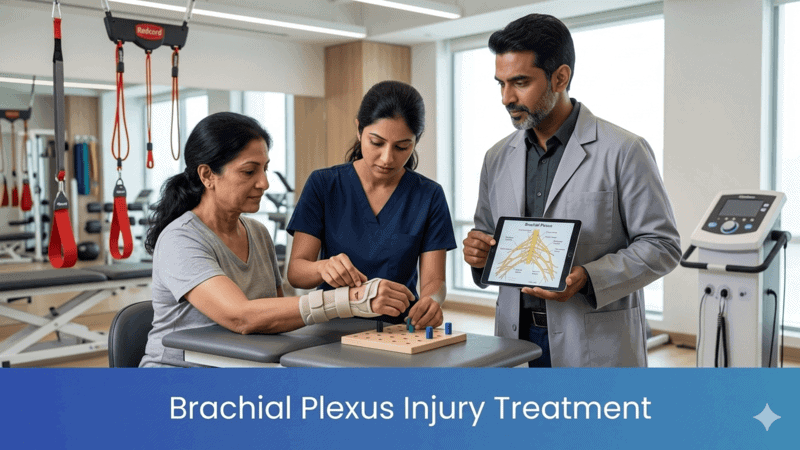
Physiotherapy within Plexus’s Brachial Plexus Injury Rehabilitation programme addresses:
- Progressive muscle strengthening across affected motor groups, capturing and building returning nerve function
- Range of motion maintenance during the denervation period and restoration as recovery advances
- Neuromuscular electrical stimulation maintaining muscle bulk and facilitating motor activation
- Functional arm movement retraining integrating recovered motor function into daily activities
Occupational Therapy
Occupational Therapy for brachial plexus injury at Plexus delivers:
- Sensorimotor retraining restoring sensory awareness and motor integration
- Fine motor dexterity rehabilitation through progressive hand function exercises
- Brachial plexus daily activities therapy for the specific ADL limitations affecting each patient
- Mirror therapy and constraint-induced movement therapy
- Activity-based rehabilitation embedding motor recovery into meaningful occupational tasks
How Does Brachial Plexus Injury Treatment at Plexus India Compare?
| Factor | Standard Brachial Plexus Treatment in India | Advanced Brachial Plexus Injury Treatment at Plexus |
| Cell Therapy | Not available nationally | ISO-certified autologous mesenchymal cell therapy |
| Specialist Neuro-Physiotherapy | Variable | Postgraduate neurological physiotherapy expertise |
| Occupational Therapy Integration | Often separate referral | Integrated within single programme |
| Hand Rehabilitation | Variable | Specialist hand therapy within programme |
| Custom Splinting | Variable | Condition-specific integrated |
| Aquatic Therapy | Not hospital-integrated nationally | India’s first hospital-integrated pool |
| ISO Certification | Not standard | ISO-certified at Bangalore and Hyderabad centres |
| National Reach | Variable | Serves every Indian state and diaspora |
Who Should Consider Brachial Plexus Injury Treatment at Plexus?
The programme is most appropriate for:
- children with obstetric brachial plexus palsy at any stage of recovery
- Adults with traumatic brachial plexus injury following any mechanism of trauma
- Patients who have had surgical intervention and are in the post-surgical rehabilitation phase
- Patients whose recovery has reached a plateau with standard conservative or surgical management
- Families from across India seeking the best treatment for brachial plexus injury at a nationally accessible, ISO-certified centre
What Improvements Have Indian Patients Reported?
Indian patients from across the country who have completed advanced brachial plexus injury treatment at Plexus have reported:
- Progressive motor strength recovery across shoulder, elbow, wrist, and hand muscle groups
- Return of sensory awareness in the affected arm and hand over the rehabilitation period
- Restoration of functional arm use in daily activities that the injury had compromised
- For children, achievement of developmental milestones delayed by obstetric brachial plexus palsy
- Greater independence in daily life, occupational participation, and family function
Why Plexus Offers the Best Treatment for Brachial Plexus Injury in India
India’s Only ISO-Certified Brachial Plexus Regenerative Rehabilitation Programme
- Plexus is India’s first and only ISO-certified regenerative rehabilitation centre offering advanced brachial plexus injury treatment, providing independently verified quality assurance for the complete cell therapy process.
National and International Patient Reach
- Plexus serves brachial plexus injury patients from every Indian state and from the international diaspora at its Bangalore and Hyderabad centres.
Over 70 National and International Awards
- More than 70 awards for clinical excellence reflect consistent outcomes across the full spectrum of neurological and nerve injury conditions at Plexus.
Other Neurological Conditions Treated at Plexus India
- Specialist programmes are available for Parkinson’s Disease, Multiple Sclerosis, Spinocerebellar Ataxia, Motor Neuron Disease, Spinal Cord Injury, Stroke, Cerebral Palsy, Autoimmune Neurological Conditions, and Sports Injuries.
Source Transparency and Editorial Accountability
Supporting Evidence
Li, H., et al. (2023). Review of rehabilitation protocols for brachial plexus injury. Frontiers in Neurology, 14, 1084223. https://pmc.ncbi.nlm.nih.gov (Source for brachial plexus injury classification, injury severity spectrum, biological recovery challenges, and rehabilitation protocol evidence.)
Belova, A.N., et al. (2025). Modern Medical Rehabilitation Methods for Patients with Peripheral Nerve and Brachial Plexus Injuries. Sovrem Tekhnologii Med. https://pmc.ncbi.nlm.nih.gov (Source for contemporary rehabilitation methods including neurotrophic factor support and biological approaches to peripheral nerve and brachial plexus injury recovery.)
Talankar, T., Palsule, S. (2020). Outcomes after occupational therapy intervention for traumatic brachial plexus injury. Journal of Hand Therapy. https://www.jhandtherapy.org
Martínez-Carlón-Reina, M., et al. (2024). Systematic Review and Meta-Analysis of Intervention Techniques in Occupational Therapy for Babies and Children with Obstetric Brachial Plexus Palsy. Journal of Clinical Medicine, 13(20). https://pmc.ncbi.nlm.nih.gov
Indian Council of Medical Research (ICMR). Guidelines on Regenerative Medicine and Cell-Based Therapies. https://www.icmr.gov.in
Plexus Clinical Programme Data, used for editorial validation. Plexus
Revision Timeline: April 2026. Page first published covering brachial plexus injury treatment, advanced cell therapy brachial plexus, brachial plexus injury treatment in India, and Plexus’s Regenerative Rehabilitation Programme at Bangalore and Hyderabad centres.
Content Development Standards: Evidence Basis: All clinical statements verified against published neurology, peripheral nerve injury, and regenerative medicine research. Clinical Review: Reviewed by Plexus neurologists and rehabilitation specialists. Regulatory Alignment: Assessed against ICMR guidelines on cellular and regenerative therapies.
Last Updated: April 2026
Frequently Asked Questions
Is brachial plexus injury treatment at Plexus available at both Bangalore and Hyderabad?
Yes. Brachial plexus injury treatment is available at Plexus’s HRBR Layout in Bangalore, and at the Banjara Hills centre in Hyderabad, open Monday to Saturday from 8:30 AM to 6:30 PM. Consultations can be booked at Plexus.
Is advanced brachial plexus injury treatment at Plexus suitable for total plexus injuries?
Yes. Advanced brachial plexus injury treatment at Plexus is designed for the full severity spectrum including total plexus injuries, with every programme individually designed based on the specific injury pattern, severity, and clinical assessment findings.
How long does brachial plexus injury treatment in India at Plexus last?
Programme duration is individualised based on injury severity, recovery trajectory, and rehabilitation goals. The specialist team establishes a clear timeline at the outset and reviews it regularly based on each patient’s motor and sensory recovery progress and functional improvement.