
What Brachial Plexus Injury Takes From Daily Life
The brachial plexus is a network of nerves running from the cervical spine through the neck and into the arm, controlling movement and sensation across the shoulder, elbow, wrist, and hand. When these nerves are stretched, compressed, or torn, the functional consequences reach into every dimension of daily life.
For a child with obstetric brachial plexus palsy, it is the inability to lift an arm, bring objects to the mouth, or develop the hand coordination that shapes early learning and play. For an adult with traumatic brachial plexus injury following a road accident or sports collision, it is the shoulder that cannot be raised, the elbow that cannot flex reliably, the hand that cannot grip, type, or fasten a shirt button.
What the Evidence Says About OT for Brachial Plexus Injury Patients
Clinical Evidence Supporting Occupational Therapy
A prospective longitudinal cohort study published in the Journal of Hand Therapy, which is among the most directly relevant clinical studies on OT for brachial plexus injury patients, followed 30 adults with traumatic brachial plexus injury receiving occupational therapy focusing on sensorimotor retraining and activity-based rehabilitation across 12 months. Elbow flexion strength showed significant improvement at all time-points, with an average increase of 2.17 on the Medical Research Council scale. Significant improvements at 12 months were also seen in shoulder abduction strength and range, flexion strength and range, external rotation range, elbow extension strength and flexion range, and thumb flexion and extension strength. Upper limb function measured by QuickDASH showed significant improvement with a mean change of 18.85. PubMed
A 2024 systematic review and meta-analysis in the Journal of Clinical Medicine specifically examined occupational therapy intervention techniques for babies and children with obstetric brachial plexus palsy, confirming that occupational therapy interventions including constraint-induced movement therapy and neuromuscular electrical stimulation produce meaningful functional improvements in the affected upper extremity.
A 2023 review of rehabilitation protocols for brachial plexus injury published in Frontiers in Neurology confirmed that rehabilitation treatment is essential for improving functional outcomes, reducing pain, and supporting daily participation for both adults and children with brachial plexus injury.
Ready to Begin?
Our centres in Bengaluru (HRBR Layout) and Hyderabad are open Monday to Saturday, 8:30 AM to 6:30 PM.
What Does Occupational Therapy for Brachial Plexus Injury Address at Plexus?
Sensorimotor Retraining
- Sensorimotor retraining is the clinical foundation of OT for brachial plexus injury patients at Plexus. Because brachial plexus injury disrupts both motor output and sensory feedback simultaneously, restoring functional use of the affected arm requires retraining not just movement but the brain’s ability to receive, process, and integrate sensory information from the injured limb.
- Sensorimotor retraining at Plexus’s occupational therapy for brachial plexus injury programme includes:
- Sensory re-education therapy using graded tactile, proprioceptive, and thermal stimulation to restore sensory awareness in the affected limb
- Mirror therapy using visual feedback from the unaffected arm to activate motor patterns in the injured side
- Constraint-induced movement therapy where the unaffected limb is temporarily constrained to drive use and neural reorganisation in the affected arm
- Activity-based rehabilitation embedding sensorimotor training within meaningful daily tasks
Fine Motor Skills Therapy for Brachial Plexus Injury
Fine motor skills therapy brachial plexus at Plexus addresses the specific hand and finger coordination that brachial plexus injury compromises:
- Grip and pinch strength training using progressive resistance protocols targeting the intrinsic and extrinsic hand muscles affected by nerve injury
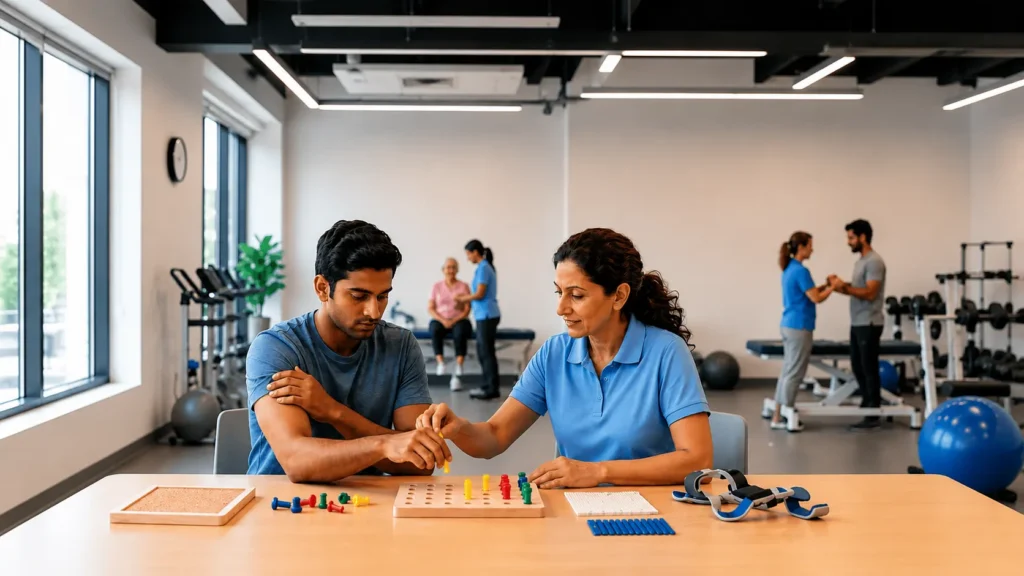
- Nine-Hole Peg Test dexterity work providing both a validated assessment measure and a structured fine motor coordination training tool
- Object manipulation training rebuilding the coordination needed for handling coins, buttons, utensils, keys, and other daily objects
- Writing and keyboard rehabilitation for patients whose professional or educational function depends on restored hand dexterity
- Bimanual coordination training reintegrating the affected limb into two-handed daily tasks
Brachial Plexus Daily Activities Therapy
Brachial plexus daily activities therapy at Plexus addresses the specific ADL limitations most commonly reported by brachial plexus injury patients across different age groups:
For children with obstetric brachial plexus palsy:
- Bringing hand to mouth for feeding and self-care tasks
- Toy manipulation and play-based hand function development
- School-readiness activities including drawing, cutting, and writing
- Dressing, personal care, and self-management skill building
For adults with traumatic brachial plexus injury:
- Personal care including dressing, grooming, and hygiene with affected arm involvement
- Kitchen and meal preparation using adapted techniques and equipment
- Occupational and vocational skill restoration including keyboard use, tool handling, and work-specific task retraining
- Community activities and leisure participation restoration
Hand Splinting and Custom Orthotics
Custom Splinting and Orthotics is a clinically important component of occupational therapy for brachial plexus injury at Plexus. Custom splints serve multiple purposes in brachial plexus rehabilitation:
- Maintaining joint alignment and preventing contracture during the recovery period when active movement is limited
- Positioning the affected limb to facilitate functional use during daily activities
- Protecting healing nerves and joints from overstretching or abnormal loading during the early recovery phase
- Providing external support that enables functional tasks the patient cannot yet perform with active muscle control alone
Muscle Re-Education and Retraining
Where nerve regeneration is occurring, muscle re-education at Plexus focuses on capturing and strengthening the earliest returning motor signals:
- Electromyographic biofeedback training helping patients detect and amplify early motor activation that may not yet be visible in observable movement
- Neuromuscular electrical stimulation applied to facilitate muscle contraction and maintain muscle bulk during the denervation period
- Progressive active-assisted to fully active movement progression tracking nerve recovery
- Functional task practice consolidating recovered motor function into meaningful daily activities
Other Therapies Available at Plexus for Brachial Plexus Injury
At Plexus, occupational therapy for brachial plexus injury is integrated within a multidisciplinary regenerative rehabilitation programme designed to support nerve recovery, upper limb function, and long-term daily independence.
Depending on the patient’s injury pattern, recovery stage, and functional limitations, the programme may also include:
Physiotherapy for Brachial Plexus Injury
Physiotherapy at Plexus focuses on improving shoulder stability, joint mobility, muscle strength, posture, and upper limb movement patterns affected by brachial plexus injury. The rehabilitation programme may include a range of motion exercises, assisted movement training, neuromuscular retraining, strengthening protocols, posture correction, and functional upper limb rehabilitation designed to support recovery and reduce stiffness-related complications.
Cell Therapy and Regenerative Rehabilitation
Occupational therapy for brachial plexus injury at Plexus is integrated within the Regenerative Rehabilitation Programme, where cell therapy is used alongside rehabilitation therapies to support the neurobiological environment associated with nerve recovery, motor retraining, and functional rehabilitation. The programme combines regenerative rehabilitation principles with structured therapy aimed at improving upper limb function and daily independence.
How Does OT for Brachial Plexus Injury Patients Integrate With the Wider Programme?
Occupational therapy for brachial plexus injury at Plexus is coordinated within the Regenerative Rehabilitation Programme alongside:
- cell therapy providing the neurobiological foundation for nerve regeneration support
- Physiotherapy for shoulder strength, range of motion, and upper limb motor retraining
- Hand Rehabilitation for specialised hand function and splinting
- Brachial Plexus Injury Rehabilitation as the overarching programme structure
Who Should Consider Occupational Therapy for Brachial Plexus Injury at Plexus?
Plexus’s clinical team assesses each patient individually. The programme is most appropriate for:
- Infants and children with obstetric brachial plexus palsy including Erb’s palsy and Klumpke’s palsy, who are experiencing difficulty with arm movement, hand use, or the upper limb activities of early development and daily life
- Adults with traumatic brachial plexus injury following road accidents, sports injuries, falls, or other trauma, in whom upper limb weakness, sensory loss, or daily function limitation is the primary clinical concern
- Patients who have undergone surgical intervention for brachial plexus injury and are entering the post-surgical rehabilitation phase where occupational therapy drives functional recovery
- Patients whose brachial plexus injury has reached a plateau with standard rehabilitation and who are seeking a more intensive, neurobiologically supported programme
What Improvements Have Patients Experienced?
Patients and families who have completed occupational therapy for brachial plexus injury at Plexus have reported:
- Progressive improvement in the ability to lift the arm, flex the elbow, and use the hand for daily tasks over the course of the rehabilitation programme
- Restoration of the ability to bring food to the mouth independently, a key functional milestone particularly meaningful for children and families
- Improved grip and pinch strength enabling more reliable handling of everyday objects including utensils, clothing, and writing tools
- Return to two-handed daily activities including dressing, cooking, and self-care that the injury had made impractical without assistance
- Improved sensory awareness in the affected limb, with patients describing the gradual return of the ability to feel and locate touch, temperature, and position
Why Plexus Is India’s Leading Centre for Occupational Therapy for Brachial Plexus Injury
Evidence-Based Sensorimotor and Activity-Based OT Approach
- Plexus’s occupational therapy for brachial plexus injury uses the sensorimotor retraining and activity-based rehabilitation approach confirmed in the published clinical evidence to produce significant improvements in motor recovery and upper limb function.
India’s First ISO-Certified Regenerative Rehabilitation Centre
- ISO certification at Plexus covers the complete regenerative rehabilitation process, providing quality assurance for the neurobiological component that supports nerve recovery alongside occupational therapy.
Specialist Hand Rehabilitation Infrastructure
- Plexus’s Hand Rehabilitation and Custom Splinting and Orthotics capabilities are integrated within the brachial plexus programme, providing the full clinical infrastructure that effective brachial plexus OT demands.
Over 70 National and International Awards
- More than 70 awards for clinical excellence reflect consistent rehabilitation outcomes at Plexus for patients with complex neurological and nerve injury conditions including brachial plexus injury.
Other Neurological Conditions Treated at Plexus
- Specialist programmes are available for Parkinson’s Disease, Multiple Sclerosis, Spinocerebellar Ataxia, Motor Neuron Disease, Spinal Cord Injury, Stroke, Cerebral Palsy, Autoimmune Neurological Conditions, and Sports Injuries.
Ready to Begin?
Our centres in Bengaluru (HRBR Layout) and Hyderabad are open Monday to Saturday, 8:30 AM to 6:30 PM.
Source Transparency and Editorial Accountability
Supporting Evidence
- Talankar, T., Palsule, S. (2020). Outcomes after occupational therapy intervention for traumatic brachial plexus injury: A prospective longitudinal cohort study. Journal of Hand Therapy. https://www.jhandtherapy.org (Source for significant improvements in elbow flexion strength, shoulder abduction, upper limb function QuickDASH scores following OT sensorimotor retraining in 30 traumatic BPI adults across 12 months.)
- Martínez-Carlón-Reina, M., et al. (2024). Systematic Review and Meta-Analysis of Intervention Techniques in Occupational Therapy for Babies and Children with Obstetric Brachial Plexus Palsy. Journal of Clinical Medicine, 13(20), 6186.
- https://pmc.ncbi.nlm.nih.gov (Source for OT including constraint-induced movement therapy and neuromuscular electrical stimulation in obstetric brachial plexus palsy.)
- Li, H., et al. (2023). Review of rehabilitation protocols for brachial plexus injury. Frontiers in Neurology, 14, 1084223. https://pmc.ncbi.nlm.nih.gov (Source for rehabilitation treatment being essential for functional improvement and daily participation in brachial plexus injury.)
- Plexus Clinical Programme Data, used for editorial validation. Plexus
Revision Timeline: April 2026. Page first published.
Last Updated: April 2026
Frequently Asked Questions
Is occupational therapy for brachial plexus injury at Plexus available at both Bangalore and Hyderabad?
Yes. Occupational therapy for brachial plexus injury is available at Plexus’s HRBR Layout in Bangalore, and at the Banjara Hills centre in Hyderabad, open Monday to Saturday from 8:30 AM to 6:30 PM. Appointments can be booked at Plexus.
Does OT for brachial plexus injury patients at Plexus include custom splinting?
Yes. Custom splinting and orthotics is integrated within the occupational therapy for brachial plexus injury programme at Plexus, with splints designed and fabricated for each patient’s specific injury pattern, functional goals, and stage of nerve recovery.
Can occupational therapy for brachial plexus injury at Plexus help patients who have had surgery?
Yes. Occupational therapy for brachial plexus injury at Plexus is clinically essential in the post-surgical rehabilitation phase, where sensorimotor retraining and activity-based rehabilitation drive the functional recovery that surgical nerve repair initiates.
What is occupational therapy for brachial plexus injury and how does it work at Plexus?
Occupational therapy for brachial plexus injury at Plexus uses sensorimotor retraining, activity-based rehabilitation, fine motor skills therapy, muscle re-education, custom splinting, and brachial plexus daily activities therapy to restore upper limb function and daily independence for both children and adults with brachial plexus injury, integrated within the Regenerative Rehabilitation Programme at ISO-certified centres in Bangalore and Hyderabad.
Is fine motor skills therapy brachial plexus available for both children and adults at Plexus?
Yes. Fine motor skills therapy brachial plexus at Plexus is delivered for both obstetric brachial plexus palsy in children and traumatic brachial plexus injury in adults, with the assessment and intervention programme calibrated to the patient’s age, developmental stage, injury pattern, and specific functional goals.
How long does brachial plexus daily activities therapy take to show results?
Brachial plexus daily activities therapy progress depends on the severity of the nerve injury, the timing of rehabilitation initiation, and the patient’s individual recovery trajectory. The longitudinal cohort study evidence confirms significant functional improvements at 3, 6, 9, and 12 months of occupational therapy intervention. Plexus’s team reviews progress at regular intervals and adjusts the programme accordingly.