
When Parkinson’s Disease Takes the Voice
Of all the changes that Parkinson’s disease brings, the loss of voice is among the most isolating. A person who is still walking, still largely independent, still fully mentally present, begins to be unable to make themselves heard across a room. Family members lean in during dinner. Phone calls become exhausting. Public conversations feel humiliating. The person with Parkinson’s disease, who has not changed in their thoughts or their sense of self, becomes progressively less audible to the world around them.
Speech problems in Parkinson’s disease are not simply a nuisance symptom. Research confirms that up to 90 percent of people with Parkinson’s disease experience voice and speech difficulties at some point during the course of their condition. These problems arise from the same neurodegeneration that drives motor symptoms, affecting the muscles of the larynx, face, mouth, and respiratory system through progressively reduced amplitude of motor output.
At Plexus, speech therapy for Parkinson’s disease is delivered as part of a fully integrated Regenerative Rehabilitation Programme by specialist speech and language therapists with specific expertise in Parkinson’s disease communication and swallowing disorders, at ISO-certified centres in Bangalore and Hyderabad. Founded by Dr. Na’eem Sadiq with over 35 years of neurological expertise, Plexus offers the most clinically evidence-grounded Parkinson’s disease speech therapy programme available in India.
Ready to Begin?
Our centres in Bengaluru (HRBR Layout) and Hyderabad are open Monday to Saturday, 8:30 AM to 6:30 PM.
What Parkinson’s Speech Problems Actually Are: The Clinical Reality
Speech therapy for Parkinson’s patients at Plexus begins with an accurate understanding of what Parkinson’s disease does to communication. The condition produces a distinct pattern of speech and voice impairment known as hypokinetic dysarthria, characterised by:
- Hypophonia: Reduced vocal loudness is the most clinically prominent speech feature of Parkinson’s disease. Patients describe their voice as feeling normal while family members and clinicians observe it as significantly reduced in volume. This disconnect arises because neurodegeneration impairs both the motor output required for adequate vocal loudness and the sensory feedback that would normally alert the speaker that their voice has become too quiet.
- Monopitch: Reduced variation in vocal pitch produces a flat, monotone quality that reduces the expressiveness of speech and makes it harder for listeners to follow the intended meaning of utterances.
- Imprecise Articulation: Reduced amplitude of articulatory movement produces consonant imprecision and vowel distortion that progressively reduces speech intelligibility, particularly in noisy environments such as the family kitchen, in restaurants, or during family gatherings.
- Reduced Speech Rate Control: Some patients present with accelerated speech, particularly festination of speech, where words run together and intelligibility drops rapidly in longer utterances.
- Hypernasality: Reduced velopharyngeal closure contributes a nasal resonance quality that further reduces speech clarity in some patients.
- Dysphagia: Swallowing difficulties arising from the same reduced amplitude of oral and pharyngeal motor output that affects speech. Dysphagia in Parkinson’s disease carries genuine nutritional safety risks and is addressed through dedicated Swallowing Therapy integrated within Plexus programme.
What Does the Evidence Say About Speech Therapy for Parkinson’s Disease?
Plexus approach to Parkinson’s speech problems treatment is grounded in the strongest available clinical evidence. The research base for speech therapy in Parkinson’s disease has grown substantially over recent years:
A major randomised controlled trial published in The BMJ in July 2024, led by researchers at the Universities of Nottingham and Birmingham and funded by the National Institute for Health Research, enrolled 388 people with Parkinson’s disease and dysarthria across 40 NHS sites. The trial demonstrated that intensive behavioural voice treatment using the Lee Silverman Voice Treatment approach was more effective at reducing the impact of dysarthria than both standard speech therapy and no treatment. The LSVT LOUD programme, delivered in 16 sessions over four weeks, produced greater reductions in patient-reported voice problem impact than the NHS-provided speech and language therapy, which showed no evidence of benefit compared to no therapy at all. ScienceDaily
A systematic review and meta-analysis published in a peer-reviewed journal and drawing on ten randomised controlled trials confirmed that LSVT training significantly improved vocal loudness, functional communication, and scores on the unified Parkinson’s disease rating scale speech item among individuals with Parkinson’s disease. PubMed Central
Research has also confirmed that up to 90 percent of individuals with Parkinson’s disease experience voice and speech problems during the course of their condition. PubMed Central
The evidence consistently supports an intensive, high-effort, voice-focused approach as the most effective model for speech therapy for Parkinson’s patients, precisely the model on which Plexus Parkinson’s speech therapy programme is built.
How Does Speech Therapy for Parkinson’s Disease Work at Plexus?
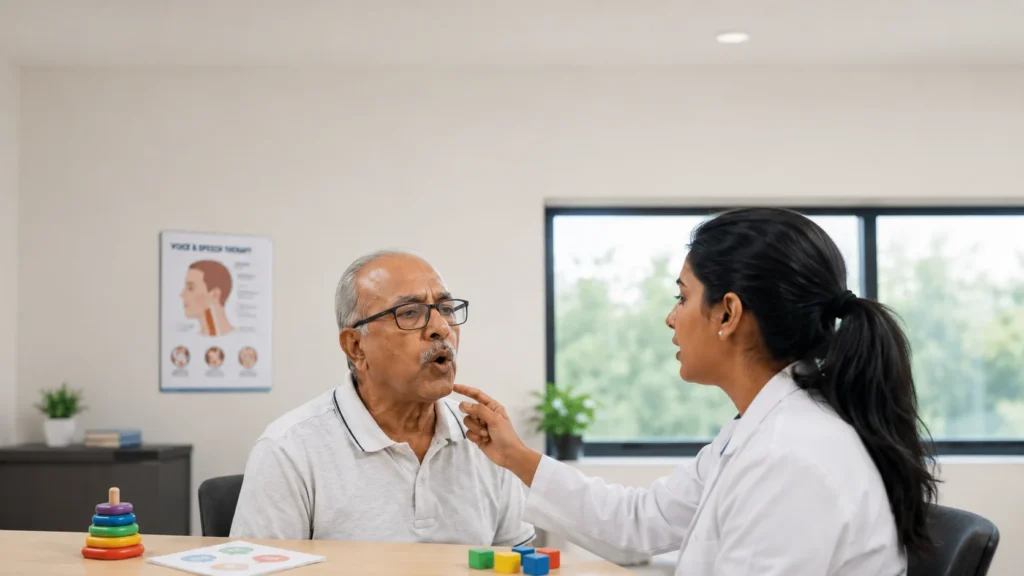
Speech therapy for Parkinson’s patients at Plexus is delivered by specialist speech and language therapists with Parkinson’s-specific clinical expertise, using an intensive, evidence-based methodology:
Intensive Voice Treatment
Drawing on the principles of intensive behavioural voice treatment validated in clinical trials, Plexus speech therapists work with Parkinson’s patients on:
- Increasing vocal loudness to functionally normal levels through high-effort voice exercises that recalibrate the patient’s perception of their own voice output
- Training patients to sustain adequate vocal loudness in real-world communication environments, including during extended conversation, telephone calls, and group settings
- Rebuilding the sensory-motor feedback loop that allows patients to self-monitor and maintain their voice without conscious effort in daily life
Articulation and Intelligibility Work
Where consonant imprecision and vowel distortion are reducing speech intelligibility, targeted articulation work at Plexus addresses:
- Oral motor exercises to improve the range and precision of articulatory movement
- Consonant clarity training targeting the specific phonemes most affected by hypokinetic dysarthria
- Intelligibility exercises in progressively complex listening environments
Speech Rate and Prosody Training
For patients presenting with festinating or accelerated speech, Plexus speech therapy programme addresses:
- Speech rate regulation techniques using pacing strategies and self-monitoring training
- Prosodic variation exercises to restore natural sentence rhythm, stress, and intonation patterns
- Expressive communication strategies to compensate for reduced prosodic range
Dysphagia and Swallowing Safety
Swallowing Therapy is delivered alongside Speech Therapy for Parkinson’s patients in whom dysphagia is part of the clinical picture:
- Oral motor strengthening exercises targeting the muscles involved in bolus preparation and propulsion
- Postural adjustment strategies and head positioning techniques to improve pharyngeal clearance and reduce aspiration risk
- Food and fluid texture modification guidance to maintain safe oral intake while nutritional goals are preserved
- Family and caregiver education on safe feeding techniques and early warning signs of aspiration
Integration with Cell Therapy and the Regenerative Rehabilitation Programme
Speech therapy for Parkinson’s disease at Plexus does not operate in isolation. It is delivered as a coordinated component of the Regenerative Rehabilitation Programme, alongside autologous mesenchymal cell therapy, Physiotherapy, Occupational Therapy, Aquatic Therapy, and Cognitive Rehabilitation. As cell therapy reduces neuroinflammation and supports broader neurological stability, the speech system engages with a more neurologically receptive substrate, enhancing the effectiveness of every speech therapy session.
What Does a Speech Therapy Consultation for Parkinson’s Disease Involve at Plexus?
The speech therapy consultation Parkinson’s assessment at Plexus is the clinical starting point from which every individual speech therapy programme is designed:
- Voice Assessment: Evaluation of vocal loudness across connected speech and sustained phonation, measurement of pitch range and variability, and assessment of voice quality including breathiness, hoarseness, and strain.
- Articulation and Intelligibility Assessment: Formal assessment of consonant and vowel production accuracy, speech intelligibility in quiet and noisy conditions, and identification of the specific phoneme targets requiring priority in treatment.
- Speech Rate and Prosody Assessment: Evaluation of conversational speech rate, identification of festination or acceleration patterns, and assessment of prosodic range across sentences and extended discourse.
- Dysphagia Screening: Where swallowing difficulties are reported or observed, a structured dysphagia screening assessment identifies the nature and severity of oral and pharyngeal phase difficulties and determines whether further instrumental assessment is required.
- Functional Communication Evaluation: Assessment of the patient’s communication participation across daily contexts, including home conversation, telephone use, social settings, and community environments.
- Caregiver Communication Interview: Input from the patient’s primary family caregiver regarding the functional impact of communication changes in daily life, which often captures dimensions of the problem that clinical assessment alone does not surface.
The outputs of this consultation directly determine the focus, intensity, and session structure of the individual speech therapy for Parkinson’s patients programme at Plexus.
How Does Parkinson’s Speech Problems Treatment at Plexus Compare to Standard Approaches?
| Factor | Standard Speech Therapy for Parkinson’s Disease | Speech Therapy for Parkinson’s Disease at Plexus |
| Evidence Base | Variable | Grounded in evidence-based intensive voice treatment validated in randomised controlled trials |
| Treatment Intensity | Often low-intensity, infrequent sessions | Intensive, high-effort programme as evidence supports |
| Clinical Integration | Typically a separate referral | Coordinated within a single Regenerative Rehabilitation Programme |
| Neurobiological Context | Delivered against ongoing neurodegeneration | Delivered alongside cell therapy in a neurologically stabilised environment |
| Swallowing Therapy | Often separate | Integrated within the same programme from the outset where indicated |
| Caregiver Involvement | Variable | Structured caregiver education integrated throughout |
| Assessment Depth | Variable | Comprehensive multi-domain speech and swallowing assessment |
| Parkinson’s Specific Expertise | Variable across centres | Specialist speech therapists with Parkinson’s disease expertise |
Who Should Consider Speech Therapy for Parkinson’s Disease at Plexus?
Plexus speech therapy team assesses each Parkinson’s patient individually. Speech therapy for Parkinson’s patients at Plexus is most appropriate for patients who:
- Are experiencing reduced vocal loudness, with family members or colleagues reporting difficulty hearing them in conversation, on the telephone, or in social settings.
- Present with reduced speech clarity, including consonant imprecision, mumbled articulation, or accelerated speech rate that is reducing intelligibility in daily communication.
- Are experiencing swallowing difficulties including choking on liquids, coughing during meals, a sensation of food sticking in the throat, or prolonged meal duration, any of which may indicate clinically significant dysphagia.
- Are in the early stages of Parkinson’s disease and wish to engage with speech and voice treatment before significant deterioration has accumulated, as evidence supports that intensive treatment produces better outcomes when initiated early.
- Are at the advanced stage of Parkinson’s disease and find that communication difficulties are significantly affecting social participation, family relationships, and quality of life.
- Have not previously received structured, intensive Parkinson’s-specific speech therapy and are seeking a speech therapy consultation Parkinson’s assessment that establishes a clear clinical baseline and individualised treatment plan.
What Improvements Have Patients Experienced Through Speech Therapy for Parkinson’s Disease at Plexus?
Parkinson’s patients who have completed speech therapy for Parkinson’s disease within Plexus Regenerative Rehabilitation Programme have reported communication improvements that are felt most acutely in daily family and social life:
- Louder and more consistently audible voice during home conversation, with family members reporting that they no longer need to strain, ask for repetition, or lean across the table to follow what is being said.
- Clearer articulation and improved speech intelligibility in public settings including shops, restaurants, and community gatherings, where communication had previously become avoided.
- More natural speech rhythm and rate, with reduced festination and improved ability to sustain intelligibility across longer utterances and extended conversation.
- Greater vocal confidence in telephone conversations, social visits, and family occasions, with patients reporting a meaningful restoration of their sense of communicative presence.
- Safer and more comfortable swallowing for patients in whom dysphagia was present, with reduced choking episodes during meals and improved confidence in eating across a broader range of food textures.
- Reduced communication-related anxiety and social withdrawal, with patients re-engaging with visits, community activities, and family meals from which they had progressively retreated.
Popularly Asked Questions
What is speech therapy for Parkinson’s disease and how does it work at Plexus?
Speech therapy for Parkinson’s disease at Plexus uses an intensive, evidence-based voice and articulation treatment approach delivered by Parkinson’s specialist speech and language therapists at ISO-certified centres in Bangalore and Hyderabad. It addresses hypophonia, dysarthria, festinating speech, and dysphagia as an integrated component of Plexus Regenerative Rehabilitation Programme.
When should speech therapy for Parkinson’s patients begin?
Speech therapy for Parkinson’s patients should begin as early as possible in the disease course, ideally before significant intelligibility decline has accumulated. Research consistently shows that intensive voice treatment produces the most durable outcomes when initiated in the early to moderate stages of Parkinson’s disease, though meaningful improvement is achievable at all stages.
What is a speech therapy consultation Parkinson’s assessment at Plexus?
A speech therapy consultation Parkinson’s assessment at Plexus is a comprehensive evaluation covering vocal loudness, articulation, speech rate, prosody, intelligibility in real-world environments, dysphagia screening, and functional communication across daily contexts. It forms the clinical baseline from which every individual speech therapy programme is designed, with caregiver input integrated from the outset.
Why Plexus Is India’s Leading Centre for Speech Therapy for Parkinson’s Disease
Evidence-Based Intensive Approach Grounded in Parkinson’s Clinical Research
- Plexus Parkinson’s speech problems treatment is built on the intensive voice treatment methodology that randomised controlled trial evidence, including the landmark 2024 BMJ trial and the established body of LSVT LOUD research, has identified as the most clinically effective approach for speech and voice disorders in Parkinson’s disease.
Specialist Speech Therapists With Parkinson’s Disease Expertise
- Plexus speech and language therapists bring condition-specific expertise in Parkinson’s hypokinetic dysarthria and dysphagia, not general communication disorders experience. This distinction matters clinically when the treatment approach, the dosage of intervention, and the family education component are all shaped by the specific neurology of the condition.
Integration With Cell Therapy and the Full Rehabilitation Programme
- Speech therapy for Parkinson’s disease at Plexus is delivered within a neurological context that no standard speech therapy service provides. Autologous mesenchymal cell therapy, delivered prior to the rehabilitation phase, creates a more neurologically receptive environment in which speech therapy gains are more meaningful and more durable. The coordination between speech therapy, Physiotherapy, Cognitive Rehabilitation, and Aquatic Therapy means that every discipline informs the others within the patient’s programme.
India’s First ISO-Certified Regenerative Rehabilitation and Research Centre
- ISO certification at Plexus covers the complete clinical programme structure, including speech therapy assessment, treatment delivery, and outcome monitoring, providing independently verified quality assurance for Parkinson’s patients at centres in Bangalore and Hyderabad.
Over 70 National and International Awards for Clinical Excellence
- More than 70 national and international awards for clinical excellence in neurological and regenerative rehabilitation reflect consistent outcomes at Plexus for patients with complex Parkinson’s disease presentations, including those for whom communication and swallowing difficulties are primary clinical concerns.
Other Neurological Conditions Treated at Plexus
Plexus expertise in speech therapy for Parkinson’s disease is part of a wider clinical commitment to neurological and regenerative care.
Specialist programmes are available for Multiple Sclerosis, Spinocerebellar Ataxia, Motor Neuron Disease, Spinal Cord Injury, Stroke, Cerebral Palsy, Brachial Plexus Injury, Autoimmune Neurological Conditions, and Sports Injuries.
Each programme draws on Cell Therapy, Physiotherapy, Occupational Therapy, Aquatic Therapy, Speech Therapy, Swallowing Therapy, and Cognitive Rehabilitation, combined and personalised to each patient’s diagnosis, goals, and stage of recovery.
Ready to Begin?
Our centres in Bengaluru (HRBR Layout) and Hyderabad are open Monday to Saturday, 8:30 AM to 6:30 PM.
Source Transparency and Editorial Accountability
Supporting Evidence
- Sackley, C.M., et al. (2024). Lee Silverman voice treatment versus NHS speech and language therapy versus control for dysarthria in people with Parkinson’s disease (PD COMM): pragmatic, UK based, multicentre, three arm, parallel group, unblinded, randomised controlled trial. BMJ, 386, e078341. https://www.bmj.com (Source for LSVT LOUD superiority over standard speech therapy in Parkinson’s disease, July 2024 randomised controlled trial with 388 participants across 40 NHS sites.)
- Pu, T., Kong, X., et al. (2022). Lee Silverman Voice Treatment to Improve Speech in Parkinson’s Disease: A Systematic Review and Meta-Analysis. PMC. https://pmc.ncbi.nlm.nih.gov (Source for meta-analysis of ten randomised controlled trials demonstrating LSVT efficacy in improving vocal loudness and functional communication in Parkinson’s disease.)
- Ramig, L.O., et al. (2001). Intensive voice treatment for patients with Parkinson’s disease: a 2-year follow-up. Journal of Neurology, Neurosurgery and Psychiatry, 71, 493-498. (Source for long-term efficacy of intensive voice treatment in Parkinson’s disease.)
- Mahler, L.A., et al. (2012). Intensive voice treatment for Parkinson’s disease following deep brain stimulation of the subthalamic nucleus. PMC. https://pmc.ncbi.nlm.nih.gov (Source for the finding that up to 90 percent of individuals with Parkinson’s disease experience voice and speech problems during the course of the condition.)
- Bloem, B.R., Okun, M.S., Klein, C. (2021). Parkinson’s disease. The Lancet, 397(10291), 2284-2303. https://www.thelancet.com
- Indian Council of Medical Research (ICMR). Guidelines on Regenerative Medicine and Cell-Based Therapies. https://www.icmr.gov.in
- Plexus Clinical Programme Data, used for editorial validation. plexusnc.com
Revision Timeline: April 2026. Page first published covering speech therapy for Parkinson’s disease, hypokinetic dysarthria, evidence for intensive voice treatment including the 2024 BMJ randomised controlled trial, swallowing therapy, and Plexus integrated speech rehabilitation programme at Bangalore and Hyderabad centres.
Content Development Standards
Evidence Basis: All clinical statements verified against published neurology, speech pathology, and movement disorder research including peer-reviewed randomised controlled trials. Clinical Review: Reviewed by Plexus neurologists and speech therapy specialists for accuracy and alignment with current treatment practice. Patient Outcome Basis: Functional improvement descriptions reflect outcomes observed within Plexus Regenerative Rehabilitation Programme. Regulatory Alignment: Assessed against ICMR guidelines on cellular and regenerative therapies.
Last Updated: April 2026
Frequently Asked Questions
Is speech therapy for Parkinson’s disease available at both Plexus centres?
Yes. Speech therapy for Parkinson’s disease is available at Plexus HRBR Layout in Bangalore, and at the Banjara Hills centre in Hyderabad, open Monday to Saturday from 8:30 AM to 6:30 PM. Speech therapy consultations for Parkinson’s patients can be booked at plexusnc.com.
What Parkinson’s speech problems does treatment at Plexus address?
Parkinson’s speech problems treatment at Plexus addresses hypophonia, dysarthria including consonant imprecision and vowel distortion, monopitch, festinating speech, and dysphagia, through an intensive evidence-based speech therapy programme delivered by Parkinson’s specialist speech and language therapists integrated within the Regenerative Rehabilitation Programme.
How is speech therapy for Parkinson’s patients at Plexus different from general speech therapy?
Speech therapy for Parkinson’s patients at Plexus is delivered by speech therapists with specific Parkinson’s disease expertise, using an intensive voice treatment methodology validated in randomised controlled trials specifically for Parkinson’s hypokinetic dysarthria, integrated within a broader Regenerative Rehabilitation Programme that includes cell therapy, Physiotherapy, and Cognitive Rehabilitation. This clinical integration and Parkinson’s-specific methodology distinguishes it from general speech therapy services.
Does speech therapy consultation for Parkinson’s at Plexus include swallowing assessment?
Yes. The speech therapy consultation Parkinson’s assessment at Plexus includes dysphagia screening for all Parkinson’s patients. Where swallowing difficulties are identified, Swallowing Therapy is integrated within the programme alongside Speech Therapy to address both communication and nutritional safety dimensions of the condition.
Can speech therapy for Parkinson’s disease at Plexus help patients in the advanced stages?
Yes. Speech therapy for Parkinson’s disease at Plexus is relevant at all stages of the condition. Research confirms that intensive voice treatment produces meaningful improvements in vocal loudness and intelligibility even in patients with significant communication difficulties, making it clinically worthwhile at both early and advanced stages of Parkinson’s disease.
How long does speech therapy for Parkinson’s patients at Plexus last?
Speech therapy programme duration is individualised following the initial speech therapy consultation Parkinson’s assessment. The specialist team establishes a structured timeline at the outset and reviews it regularly, adjusting intensity and focus based on each patient’s vocal, articulatory, and swallowing profile and rate of progress through the programme.