
Why Physiotherapy Is Not Optional in Parkinson’s Disease
Parkinson’s disease is commonly understood as a condition managed with medication. For many patients, that understanding shapes years of clinical experience before physiotherapy enters the picture. And by the time it does, it often enters too late, after gait has deteriorated, falls have begun, and muscle patterns have adapted to the condition in ways that take considerably more effort to reverse.
The evidence is unambiguous. Physiotherapy for Parkinson’s disease, delivered early, consistently, and by specialists with condition-specific expertise, produces meaningful improvements in motor function, gait, balance, and quality of life that medication cannot achieve. A 2023 systematic review and meta-analysis including 42 randomised controlled trials with 2,530 participants confirmed that across all types of physiotherapy treatment for Parkinson’s disease, strength training, mind-body exercise, and aerobic exercise were effective in improving motor symptoms as measured by the Unified Parkinson’s Disease Rating Scale.
A 2020 meta-analysis of 191 trials with 7,998 participants established that conventional physiotherapy significantly improved motor symptoms, gait, and quality of life in Parkinson’s disease, with resistance training improving gait, treadmill training improving gait, strategy training improving balance and gait, and dance, Nordic walking, and balance and gait training all improving motor symptoms, balance, and gait.
Ready to Begin?
Our centres in Bengaluru (HRBR Layout) and Hyderabad are open Monday to Saturday, 8:30 AM to 6:30 PM.
What Does the Evidence Say About Physiotherapy for Parkinson’s Disease?
Plexus’s physiotherapy treatment for Parkinson’s disease is grounded in the most current peer-reviewed clinical evidence:
- A 2025 systematic review and dose-response meta-analysis published in npj Parkinson’s Disease, drawing on 30 studies with 2,932 participants, confirmed that balance impairments are among the most disabling symptoms of Parkinson’s disease and are often poorly responsive to pharmacological therapy, and that physiotherapy is a key non-pharmacological intervention to improve postural control. Nature
- A Cochrane systematic review and network meta-analysis of physical exercise for Parkinson’s disease confirmed that physical exercise is effective in managing Parkinson’s disease through several types including aquatic therapy, dance, physiotherapy, exercises targeted at freezing of gait, and strength and resistance and endurance training. PubMed Central
- The American Physical Therapy Association’s clinical practice guideline for Parkinson’s disease confirmed that aerobic exercise has been shown to improve various aspects of function and quality of life in individuals with Parkinson’s disease, with improvements in gait-related outcomes, balance, and activities of daily living demonstrated in high-quality and moderate-quality studies. Oxford Academic
- Research published in PMC on early and regular physiotherapy in Parkinson’s disease confirms that there is a growing body of evidence revealing the benefits of physical therapy and exercise to mitigate motor and nonmotor signs while improving physical function and reducing disability, and that the presence of early disability coupled with the benefits of exercise suggests that physical therapy should be initiated earlier in the disease. PubMed Central
What Does Physiotherapy Treatment for Parkinson’s Disease Involve at Plexus?
Parkinson’s disease rehabilitation physiotherapy at Plexus is structured across six core clinical areas, each grounded in the evidence base for Parkinson’s-specific physiotherapy:
Gait Retraining and Stride Correction
Parkinson’s disease produces a characteristic shuffling gait with reduced stride length, impaired arm swing, and festinating steps. Physiotherapy treatment for Parkinson’s disease at Plexus addresses gait through:
- Treadmill and overground gait training using progressive walking protocols that improve stride length, cadence, and walking velocity
- Rhythmic auditory cueing to bypass the disrupted internal timing mechanisms of the basal ganglia and restore more normal step initiation and rhythm
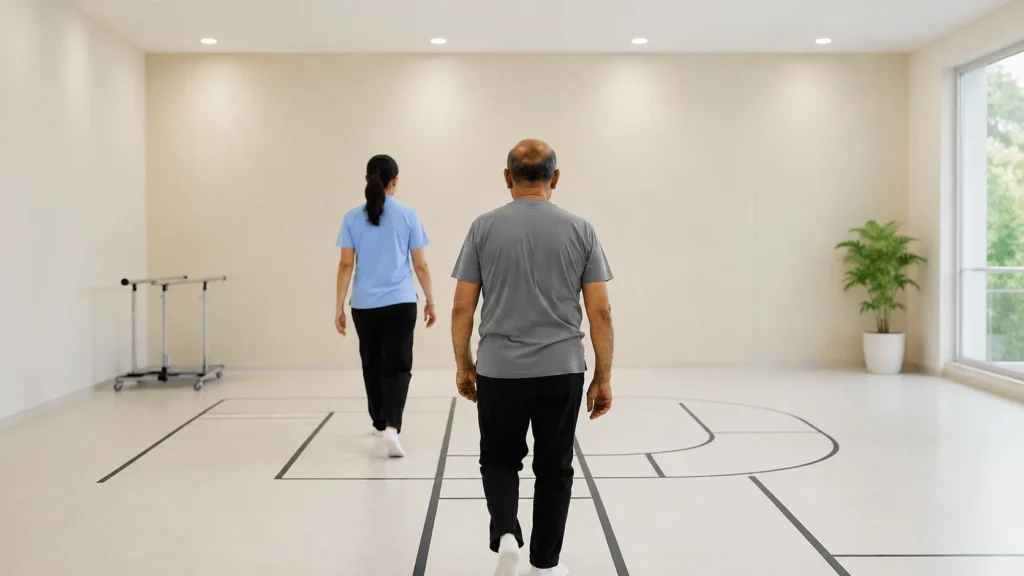
- Visual cueing strategies using floor markers and environmental cues to improve step length and reduce freezing episodes during walking
- Dual-task gait training for patients in whom simultaneous cognitive demands significantly worsen gait performance
Freezing of Gait Intervention
Research confirms that dedicated training aimed at reducing freezing of gait episodes has a moderate effect size across multiple studies and is significantly more effective than generic exercise for patients in whom freezing is a primary concern. At Plexus, freezing-specific physiotherapy includes:
- Freezing trigger identification and avoidance strategy training for common environmental contexts including doorways, turns, and narrow spaces
- Rhythmic cueing and attentional focus strategies specifically targeted at the moments of gait initiation and directional change where freezing is most likely to occur
- Stepping-in-place and stepping-over-obstacle drills that retrain the motor patterns disrupted by basal ganglia dysfunction
Balance and Postural Stability Training
Evidence confirms that physiotherapy significantly improves balance and postural stability in Parkinson’s disease. Parkinson’s disease physiotherapy exercises at Plexus for balance include:
- Static and dynamic balance challenges progressing from stable to unstable surfaces, from eyes-open to eyes-closed conditions, and from single-task to dual-task demands
- Anticipatory postural adjustment training to improve the preparatory motor commands that stabilise posture before voluntary movement
- Reactive balance training targeting the postural righting responses that are specifically impaired by the loss of dopaminergic neurons governing basal ganglia circuitry
- Sensorimotor integration exercises that retrain the system’s ability to weight and combine visual, vestibular, and proprioceptive inputs for postural control
Resistance and Strength Training
Resistance training is supported by multiple high-quality randomised controlled trials as an effective physiotherapy treatment for Parkinson’s disease improving gait, mobility, and function. At Plexus:
- Progressive resistance exercises target the trunk, upper limb, and lower limb muscle groups most affected by Parkinson’s rigidity and reduced motor output
- Functional strengthening is prioritised, with exercises selected for their direct carry-over to activities including rising from a chair, climbing stairs, and transferring safely
- Body-weight and load-bearing strength work is structured around the patient’s current functional capacity and progressed according to response
Rigidity and Bradykinesia Management
Parkinson’s disease physiotherapy exercises at Plexus for rigidity and bradykinesia include:
- Passive and active range-of-motion exercises targeting the axial and appendicular rigidity that limits functional movement across daily activities
- Amplitude-focused movement training using LSVT BIG principles, training patients to produce larger-than-normal movements to compensate for the reduced amplitude that characterises Parkinson’s motor output
- Agility training targeting the speed, coordination, and sequence of functional movements including turning, reaching, and transferring between positions
Aerobic Exercise and Cardiovascular Conditioning
Evidence supports aerobic exercise as an effective component of physiotherapy treatment for Parkinson’s disease for improving gait capacity, walking speed, and functional endurance. At Plexus:
- Supervised aerobic exercise programmes using treadmill walking, overground walking, and stationary cycling are structured around each patient’s cardiovascular capacity and safety profile
- Nordic walking training, which evidence identifies as beneficial for both motor and non-motor Parkinson’s symptoms, is incorporated where appropriate
- Aerobic conditioning is integrated with balance and gait work to produce specificity of training effect across the motor functions most relevant to daily independence
How Does Parkinson’s Disease Rehabilitation Physiotherapy at Plexus Integrate With the Wider Programme?
Physiotherapy for Parkinson’s disease at Plexus does not operate as a standalone service. It is a clinically coordinated component of the Regenerative Rehabilitation Programme, delivered alongside:
- Autologous mesenchymal cell therapy, which stabilises the neurological environment and creates a more responsive brain for physiotherapy to engage with, producing more durable functional gains
- Occupational Therapy for daily independence, with physiotherapy motor gains directly reinforced through occupational task practice
- Aquatic Therapy at India’s first hospital-integrated pool, providing a complementary balance and strength training environment that extends and reinforces land-based physiotherapy gains
- Speech Therapy and Swallowing Therapy where communication and nutrition are clinically affected
- Cognitive Rehabilitation where attentional function and dual-task performance are relevant to gait and balance training goals
How Does Physiotherapy for Parkinson’s Disease at Plexus Compare to Standard Physiotherapy?
| Factor | Standard Physiotherapy for Parkinson’s Disease | Parkinson’s Disease Rehabilitation Physiotherapy at Plexus |
| Specialist Expertise | General physiotherapy | Neuro-physiotherapists with Parkinson’s disease-specific qualifications |
| Evidence Basis | Variable | Grounded in Cochrane reviews, RCT evidence, and APTA clinical practice guidelines |
| Gait Training | General exercise | Parkinson’s-specific treadmill, cueing, and freezing of gait protocols |
| Freezing of Gait | Rarely targeted specifically | Dedicated freezing intervention programme |
| Amplitude Training | Not standard | LSVT BIG-consistent amplitude-focused movement retraining |
| Aquatic Therapy | Not available at most centres | Integrated within programme at India’s first hospital-based pool |
| Programme Coordination | Separate from medical care | Fully integrated with cell therapy and rehabilitation disciplines |
| Neurological Context | Against ongoing neurodegeneration | Alongside cell therapy in a neurologically stabilised environment |
Who Should Consider Physiotherapy for Parkinson’s Disease at Plexus?
Plexus’s physiotherapy team assesses each patient individually. The programme is most appropriate for patients who:
- Have a confirmed Parkinson’s disease diagnosis with motor symptoms including gait difficulty, balance impairment, freezing of gait, rigidity, or bradykinesia affecting daily function and independence.
- Have not previously received structured, Parkinson’s-specific physiotherapy and are seeking evidence-based Parkinson’s disease physiotherapy exercises from specialist neuro-physiotherapists.
- Are in the early stages and wish to initiate physiotherapy before significant gait and balance decline has accumulated, maximising the long-term functional benefits of early rehabilitation.
- Have experienced falls or near-falls and wish to engage a structured fall prevention programme within a Parkinson’s disease rehabilitation physiotherapy framework.
- Are seeking physiotherapy treatment for Parkinson’s disease integrated within a programme that includes cell therapy, occupational therapy, aquatic therapy, and specialist coordination across disciplines.
What Improvements Have Patients Experienced Through Physiotherapy for Parkinson’s Disease at Plexus?
Patients who have completed Parkinson’s disease rehabilitation physiotherapy within Plexus’s programme have reported:
- More fluid and consistent walking pattern, with improved stride length, reduced shuffling, and greater arm swing during movement.
- Significant reduction in freezing episodes at doorways, turns, and transitions, with cueing strategies providing reliable tools for independent management of freezing moments.
- Improved balance confidence and reduced fall frequency, with patients reporting the ability to walk on uneven surfaces, navigate staircases, and move through crowded environments with greater safety.
- Reduced rigidity and morning stiffness, with greater ease of movement initiation at the start of the day and after periods of rest.
- Greater amplitude of movement across daily activities including reaching, turning, and transferring, supported by amplitude-focused exercise principles integrated within the programme.
- Improved aerobic capacity and endurance for daily activity, with patients reporting the ability to walk further, participate in family outings, and sustain activity for longer without disproportionate fatigue.
Why Plexus Offers India’s Most Comprehensive Parkinson’s Disease Rehabilitation Physiotherapy
Specialist Neuro-Physiotherapists With Parkinson’s Disease Expertise
- Plexus’s physiotherapy team at Bangalore and Hyderabad comprises neuro-physiotherapists with postgraduate qualifications specifically in neurological rehabilitation, including Parkinson’s disease-specific clinical expertise, delivering condition-specific protocols rather than generalised exercise programmes.
India’s First Hospital-Based Aquatic Therapy Pool
- Plexus’s hospital-integrated Aquatic Therapy pool extends the physiotherapy programme with water-based balance and resistance training that is particularly valuable for Parkinson’s patients with significant fall risk or postural instability.
Neurological Context Through Cell Therapy
- Physiotherapy at Plexus is delivered within a neurologically stabilised environment created by autologous mesenchymal cell therapy, producing more durable rehabilitation gains than physiotherapy against unchecked neurodegeneration can achieve.
Over 70 National and International Awards for Clinical Excellence
- More than 70 awards for clinical excellence in neurological and regenerative rehabilitation reflect consistent physiotherapy and rehabilitation outcomes at Plexus across Parkinson’s disease at every stage.
Other Neurological Conditions Treated at Plexus
Specialist programmes are available for Multiple Sclerosis, Spinocerebellar Ataxia, Motor Neuron Disease, Spinal Cord Injury, Stroke, Cerebral Palsy, Brachial Plexus Injury, Autoimmune Neurological Conditions, and Sports Injuries.
Ready to Begin?
Our centres in Bengaluru (HRBR Layout) and Hyderabad are open Monday to Saturday, 8:30 AM to 6:30 PM.
Source Transparency and Editorial Accountability
Supporting Evidence
- Yang, Y., et al. (2023). Effect of Physiotherapy Interventions on Motor Symptoms in People With Parkinson’s Disease: A Systematic Review and Meta-Analysis. Biological Research for Nursing, 25(4), 586-605. https://pubmed.ncbi.nlm.nih.gov (Source for 42 RCT meta-analysis confirming strength training, mind-body exercise, and aerobic exercise effectiveness on UPDRS motor scores.)
- Radder, D.L.M., et al. (2020). Physiotherapy in Parkinson’s Disease: A Meta-Analysis of Present Treatment Modalities. Neurorehabilitation and Neural Repair. https://journals.sagepub.com (Source for 191-trial meta-analysis confirming conventional physiotherapy, resistance training, treadmill training, strategy training, dance, and balance and gait training effectiveness in Parkinson’s disease.)
- American Physical Therapy Association. (2022). Physical Therapist Management of Parkinson Disease: A Clinical Practice Guideline. Physical Therapy. https://academic.oup.com (Source for aerobic exercise, resistance training, and gait evidence in Parkinson’s disease, high-quality and moderate-quality studies.)
- Gilat, M., et al. (2021). A systematic review on exercise and training-based interventions for freezing of gait in Parkinson’s disease. npj Parkinson’s Disease. https://www.nature.com (Source for moderate effect size of physical therapy on subjective FOG severity across 41 studies and 1,838 patients.)
- Ellis, T., Earhart, G.M. (2021). Evidence for Early and Regular Physical Therapy and Exercise in Parkinson’s Disease. PMC. https://pmc.ncbi.nlm.nih.gov (Source for early disability evidence, gait speed decline data, and benefits of early physiotherapy initiation in Parkinson’s disease.)
- Bocci, T., et al. (2025). Physiotherapy interventions for balance impairments in Parkinson’s disease: evidence from a systematic review and dose-response meta-analysis. npj Parkinson’s Disease. https://www.nature.com (Source for balance impairments as a primary target for physiotherapy in Parkinson’s disease, 30 studies with 2,932 participants.)
- Indian Council of Medical Research (ICMR). Guidelines on Regenerative Medicine and Cell-Based Therapies. https://www.icmr.gov.in
- Plexus Clinical Programme Data, used for editorial validation. Plexus
Revision Timeline: April 2026. Page first published.
Last Updated: April 2026
Frequently Asked Questions
Is physiotherapy for Parkinson’s disease available at both Plexus centres?
Yes. Physiotherapy for Parkinson’s disease is available at Plexus’s Bangalore centres in HRBR Layout, and at the Banjara Hills centre in Hyderabad, open Monday to Saturday from 8:30 AM to 6:30 PM. Appointments can be booked at Plexus.
Who delivers Parkinson’s disease rehabilitation physiotherapy at Plexus?
Parkinson’s disease rehabilitation physiotherapy at Plexus is delivered by Dr. Navin Kumar R, MPT at Bangalore, a neuro-physiotherapist with a Master’s specialising in Neurology from KMCH College of Physiotherapy, and Dr. Amulya Bodke, MPT at Hyderabad, a neuro-physiotherapist with a Master’s in Neurological and Psychosomatic Disorders from Nitte Institute of Physiotherapy.
Can Parkinson’s disease physiotherapy exercises at Plexus help patients who have already had falls?
Yes. Fall history is a specific component of the initial clinical assessment at Plexus. Where falls are a primary concern, the Parkinson’s disease physiotherapy exercises programme specifically prioritises balance and reactive postural training, freezing of gait intervention, and aquatic therapy-based balance work in a fall-safe environment.
How does Parkinson’s disease rehabilitation physiotherapy at Plexus differ from general physiotherapy?
Parkinson’s disease rehabilitation physiotherapy at Plexus is delivered by specialist neuro-physiotherapists using Parkinson’s-specific protocols grounded in Cochrane reviews and APTA clinical guidelines, within a cell therapy programme that creates a neurologically stable rehabilitation environment. General physiotherapy centres do not typically offer this combination of condition-specific expertise, neurological context, and integrated programme coordination.