
Reviewed by Dr. Na’eem Sadiq, Senior Neurologist | Plexus Neuro and Cell Therapy Centre, Bengaluru and Hyderabad | June 2026
Quick Answer
Parkinson’s disease can cause a distinctive pattern of balance problems that often respond less reliably to medication than tremor or stiffness. Postural instability, changes in gait, slowed reaction time, and the cognitive demands of walking all contribute to a fall risk that increases as the condition progresses. Falls in Parkinson’s disease should be taken seriously because they can lead to injury, fear of walking and loss of independence.
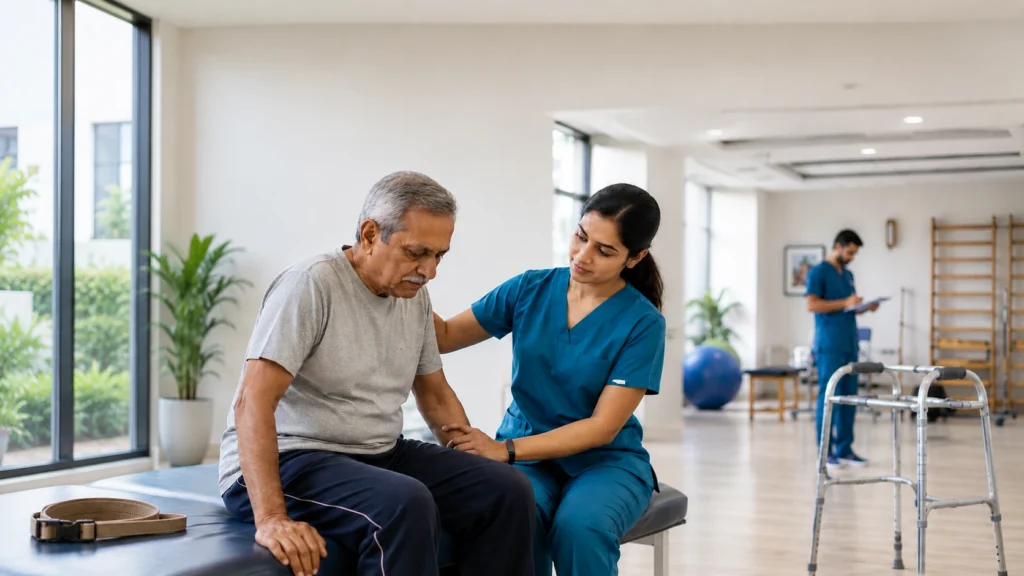
Specialist physiotherapy, aquatic therapy, and occupational therapy form the clinical approach to balance and fall prevention. Physiotherapy addresses gait, posture, and the reactive stepping responses that catch a stumble. Aquatic therapy provides a supported, lower-risk environment for balance practice. Occupational therapy reduces fall hazards in the home and teaches safe movement strategies for daily activities.
The balance and fall prevention programme at Plexus Neuro and Cell Therapy Centre in Bengaluru and Hyderabad is part of the integrated Regenerative Rehabilitation Programme for Parkinson’s disease, delivered under the clinical leadership of Dr. Na’eem Sadiq.
Key Takeaways
- Postural instability is one of the major motor features, often more prominent as Parkinson’s progresses. It does not respond consistently to levodopa and requires targeted rehabilitation.
- Gait changes in Parkinson’s disease, including shuffling steps, reduced arm swing, and festination, directly increase fall risk.
- Freezing of gait, where the feet feel unable to move during walking, is a distinct and serious cause of falls in Parkinson’s disease.
- Falls in Parkinson’s disease can cause injury and substantially affect future care needs. A first fall should be treated as a clinical warning sign, even when it appears minor.
- Physiotherapy targeting gait, balance, and reactive stepping is the primary rehabilitation approach for fall prevention.
- Aquatic therapy provides a supported environment for balance and gait training where the risk of injury during practice may be reduced.
- Occupational therapy addresses fall hazards in the home environment and teaches safe techniques for high-risk daily activities.
Speak to Our Parkinson’s Specialist Team
Our specialist team in Bengaluru (HRBR Layout) and Hyderabad provides free consultations for Parkinson’s disease rehabilitation.
Introduction
“My mother fell in the hallway last week. It was not a serious injury, but she has been frightened of walking without holding onto something since. She moves more slowly now. We are afraid to leave her alone.”
A fall in Parkinson’s disease should not be dismissed as a one-off accident, even when the injury is minor. It may be a sign that walking, balance, reaction time or confidence needs specialist assessment. The best time to address fall risk is before a serious injury occurs.
Balance problems in Parkinson’s disease arise from a combination of factors: the loss of automatic postural righting reflexes, changes to the gait pattern, slowed reaction time, and the cognitive demands of walking safely in a complex environment. These factors overlap and reinforce each other, creating a compounding risk that increases as the disease progresses. Medication adjustment does not adequately address any of them.
This guide explains why Parkinson’s disease creates balance problems, how to recognise when specialist assessment is needed, and what the balance and fall prevention programme at Plexus in Bengaluru and Hyderabad works toward for patients at every stage of the condition.
Why Parkinson’s Disease Causes Balance Problems and Fall Risk
Postural instability: why it is medication-resistant
Postural instability is one of the major motor features of Parkinson’s disease, particularly as the condition progresses. Unlike tremor and rigidity, postural instability does not respond consistently to levodopa. This is partly because balance control involves brain pathways beyond the dopamine system affecting the automatic reflexes that detect and correct imbalance.
In a person without Parkinson’s disease, a stumble or unexpected shift in balance triggers an immediate automatic corrective response: a rapid step or shift in posture that prevents a fall. In Parkinson’s disease, this response is slowed and reduced. The threshold at which a stumble becomes a fall is lower, and the capacity to recover from a perturbation is diminished. Physiotherapy specifically trains these reactive stepping responses.
Gait changes that increase fall risk
- Shuffling steps and reduced stride length lower the base of support during walking and reduce the margin for recovery from stumbles.
- Festination: a pattern of progressively quickening small steps that shifts the centre of gravity forward until a fall occurs.
- Freezing of gait: a sudden, unpredictable inability to initiate or continue walking, most common during turns, in doorways, or when approaching a destination. The torso may continue moving forward while the feet remain stationary.
- Reduced arm swing: the natural counter balancing movement of the arms during walking is reduced, affecting stability during turns and on uneven surfaces.
How cognitive changes contribute to falls
Walking safely in real-world environments requires continuous background cognitive processing: monitoring surroundings, adjusting for obstacles, planning direction changes, and ignoring distractions. As Parkinson’s disease affects cognitive processing speed, the brain has less capacity to manage both walking and any simultaneous task. Carrying a cup, responding to a question, or navigating a busy room all increase fall risk in Parkinson’s disease. This is known as dual-task interference, and it is directly addressed in the Plexus physiotherapy programme.
Warning Signs That Fall Risk Needs Specialist Attention
The following signs consistently indicate that a specialist balance and fall assessment is needed:
- A fall has occurred, even if it was minor and attributed to an environmental cause such as a step or uneven pavement.
- Near-falls or stumbles are occurring more than once a week.
- The person is holding onto walls, furniture, or a companion during walking in familiar indoor environments.
- Outdoor walking has been reduced or avoided because of fear of falling on uneven ground or in crowds.
- Freezing of gait is occurring, particularly in doorways, narrow spaces, or when turning.
- Getting up from a chair, the floor, or the bed has become effortful or unsafe to do alone.
Important: A first fall in Parkinson’s disease should not be dismissed as a one-off event, even if it caused no injury. Falls in Parkinson’s disease follow a pattern. The first fall indicates that the balance deficit has crossed a threshold that warrants specialist physiotherapy assessment. Early intervention after a first fall is usually more useful than waiting until falls become frequent.
If any of these signs apply, speak to our specialist team in Bengaluru or Hyderabad. Book a free consultation to arrange a balance and fall risk assessment.
What Happens When Fall Prevention Is Delayed
- Falls become more frequent and more severe. Without targeted balance training and cueing strategies, falls may become more frequent as the disease advances.
- Fear of falling develops. After a first fall, many patients restrict their activity, avoid outdoor walking, and reduce the physical engagement that supports balance. This restriction accelerates the physical deconditioning that increases future fall risk.
- A serious fall injury can substantially alter mobility, confidence and care needs. Hip fractures in particular are associated with significant reduction in mobility and independence in people with Parkinson’s disease.
- Caregiver burden increases. As fall risk rises without specialist support, family members face increasing demands managing safety at home, often without the clinical knowledge needed to do this effectively.
Balance and Fall Prevention at Plexus for Parkinson’s Disease
The balance and fall prevention programme at Plexus Neuro and Cell Therapy Centre combines physiotherapy, aquatic therapy, occupational therapy, and where appropriate, cell therapy within the Regenerative Rehabilitation Programme.
Physiotherapy
The physiotherapy programme at Plexus for balance and fall prevention in Parkinson’s disease includes:
- Balance training: progressing from supported to unsupported positions, with perturbation training that practices and strengthens reactive stepping responses.
- Gait training: targeting stride length, walking speed, and turning safety. Training includes practice in the environments and situations most likely to trigger freezing or stumbles.
- LSVT BIG: training deliberate, large-amplitude movements that counteract the small, shuffling movement pattern of Parkinson’s disease.
- Cueing strategies: using visual lines on the floor, rhythmic auditory cues, or mental imagery to help the brain initiate and continue steps during freezing-prone situations.
- Dual-task training: gradually adding a secondary cognitive task during walking exercises to build the attentional capacity needed for real-world safe mobility.
- Strength training: targeting the lower limbs and trunk muscles that support balance recovery from stumbles.
Aquatic Therapy
Aquatic therapy at Plexus provides a buoyant, supported environment for balance and gait training. In water, the risk of injury during balance practice may be reduced. This allows patients to practise perturbation recovery, stepping responses, and gait patterns at an intensity that may not be achievable on land without extensive supervision. The resistance of water also provides sensory feedback that supports proprioceptive awareness and postural control.
Occupational Therapy
Occupational therapy at Plexus addresses the practical and environmental dimensions of fall risk. The OT programme includes:
- Home environment assessment and modification advice: identifying and removing trip hazards, improving lighting, adding grab rails and non-slip surfaces, and reorganising high-risk areas.
- Training for safe performance of high-risk daily activities: bathroom use, stair navigation, getting in and out of bed, and entering and exiting vehicles.
- Adaptive equipment assessment: recommending appropriate walking aids, bathroom equipment, and other assistive items that reduce fall risk while preserving independence.
- Activity confidence: specifically addressing fear of falling and supporting a return to previously avoided activities in a graduated and safe way.
Cell Therapy
At Plexus, autologous mesenchymal cell therapy may be considered only for carefully selected patients after detailed neurological assessment. It uses the patient’s own cells and may be offered, where appropriate, as part of an integrated regenerative rehabilitation programme.
This approach is distinct from embryonic or donor/allogeneic stem-cell interventions. Cell therapy is not a stand-alone treatment, not a cure, and not suitable for every patient. Suitability, risks and expected outcomes are discussed individually with the clinical team before any recommendation is made
Enquire About Parkinson’s at Plexus
Our specialist team in Bengaluru and Hyderabad offers a free consultation to assess your fall risk and design a targeted plan.
What the Programme Works Toward
The balance and fall prevention programme at t Plexus works toward fewer falls, better balance confidence and safer independent mobility for as long as possible for patients with Parkinson’s disease. The specific goals of each programme are set by the clinical team in collaboration with the patient and their family, based on the current stage of the condition and the individual’s daily life and priorities.
For patients who have already experienced falls, the programme aims to interrupt the cycle of restriction and deconditioning that follows a first fall experience. For patients who have not yet fallen, the aim is to build the balance reserves and environmental safeguards that reduce the risk of a first serious fall.
Why Choose Plexus for Parkinson’s Disease
- Neurologist-led, ISO-certified programme: Dr. Na’eem Sadiq leads the clinical team with over 35 years of specialised experience in neurological and regenerative rehabilitation. Plexus is India’s first ISO-certified centre for regenerative rehabilitation.
- Integrated multidisciplinary delivery: All therapies are delivered as one coordinated programme under a single clinical team. Patients are not referred between separate providers.
- Cell therapy for carefully selected patients: Autologous mesenchymal cell therapy is offered only to carefully evaluated patients and is always delivered alongside physiotherapy and occupational therapy. It is never a standalone treatment.
- LSVT LOUD and LSVT BIG certified: Plexus therapists are certified in LSVT LOUD (voice) and LSVT BIG (movement), two of the most evidence-supported protocols for Parkinson’s disease rehabilitation.
- Personalised and continuously reviewed: Every programme is built around the patient’s specific symptoms, disease stage, and daily life goals. Plans are reviewed and updated as the condition progresses.
- Caregiver education integrated: Family members and caregivers are actively trained in home exercise programmes, handling techniques, and early warning sign recognition as part of every clinical programme.
- Virtual consultations available: Virtual consultations are available for patients who are unable to travel to the Bengaluru or Hyderabad centres.
About Plexus Neuro and Cell Therapy Centre
Plexus Neuro and Cell Therapy Centre operates ISO-certified rehabilitation centres in Bengaluru (HRBR Layout) and Hyderabad. The programme is led by Dr. Na’eem Sadiq, founder and Chief Neurologist, with over 35 years of specialised experience in neurological and regenerative rehabilitation.
- More than 500,000 patients treated across the Bengaluru and Hyderabad centres
- More than 70 national and international awards for clinical excellence in neurological rehabilitation, including recognition from Fortune India
- Internationally published research in Multiple Sclerosis, Epilepsy, Migraine, and Demyelinating Polyneuropathy
- Specialist outpatient services covering neurology, neuropsychiatric disorders, pain, stroke, cerebral palsy, epilepsy, geriatric care and sports medicine
- Comprehensive therapy services including physiotherapy, occupational therapy, speech and language therapy, cognitive rehabilitation, aquatic therapy, behaviour therapy, and swallowing therapy
- Regenerative Rehabilitation Programme for neurological conditions including Parkinson’s disease, stroke, multiple sclerosis, spinal cord injury, brachial plexus injury, cerebral palsy, and motor neuron disease
- Centres open Monday to Saturday, 8:30 AM to 6:30 PM, in Bengaluru and Hyderabad
Ready to Begin?
Our centres in Bengaluru (HRBR Layout) and Hyderabad are open Monday to Saturday, 8:30 AM to 6:30 PM.
Research and Evidence
The following peer-reviewed studies and clinical guidelines inform the rehabilitation approaches described in this blog.
- Allen NE et al. Exercise and motor training in people with Parkinson’s disease: a systematic review of participant characteristics, intervention delivery, retention rates, measurement outcomes, and adverse events in clinical trials. Parkinson’s Disease. 2012. https://doi.org/10.1155/2012/854328
- Bloem BR et al. Falls and freezing of gait in Parkinson’s disease: a review of two interconnected, episodic phenomena. Movement Disorders. 2004;19(8):871-884. https://pubmed.ncbi.nlm.nih.gov/15300651/
- Tomlinson CL et al. Physiotherapy intervention in Parkinson’s disease: systematic review and meta-analysis. British Medical Journal. 2012;345:e5004. https://pubmed.ncbi.nlm.nih.gov/22867913/
- Osborne JA et al. Physical Therapist Management of Parkinson Disease: A Clinical Practice Guideline. Physical Therapy. 2022;102(4):pzab302. https://doi.org/10.1093/ptj/pzab302
- Shen X, Mak MK. Balance and gait training with augmented feedback improves balance confidence in people with Parkinson’s disease. Neurorehabilitation and Neural Repair. 2014;28(6):524-535. https://pubmed.ncbi.nlm.nih.gov/24421309/
Frequently Asked Questions
Why does Parkinson’s disease cause balance problems?
Balance problems in Parkinson’s disease arise from the loss of automatic postural righting reflexes, changes to the gait pattern including shuffling steps and reduced arm swing, slowed reaction time, and cognitive changes that affect dual-task walking. Postural instability, one of the major motor features of Parkinson’s disease, does not respond consistently to levodopa and requires targeted rehabilitation.
Is a single fall in Parkinson’s disease serious?
Yes. A first fall in Parkinson’s disease indicates that the balance deficit has reached a threshold that warrants specialist physiotherapy assessment. Falls in Parkinson’s disease follow a pattern and a first fall is rarely an isolated event. Early assessment and intervention after a first fall is usually more effective than waiting until falls become frequent.
What is freezing of gait in Parkinson’s disease?
Freezing of gait is a sudden, temporary inability to initiate or continue walking, most common during turns, in doorways, or when approaching a destination. It is a distinct cause of falls in Parkinson’s disease and is addressed in the Plexus physiotherapy programme through cueing strategies and specific gait training.
Can physiotherapy reduce falls in Parkinson’s disease?
Structured physiotherapy targeting balance, gait, and reactive stepping, alongside home environment modification by an occupational therapist, is the primary clinical approach to fall prevention in Parkinson’s disease. The Plexus programme aims to reduce fall frequency and build balance confidence through a personalised, progressively structured plan.
What is aquatic therapy and how does it help with Parkinson’s balance?
Aquatic therapy at Plexus provides a supported, lower-risk environment where balance and gait training can be practised with close supervision. In water, patients can work on perturbation recovery and stepping responses at an intensity not easily achievable on land. The resistance of water also supports proprioceptive awareness and postural control.
How does occupational therapy help reduce fall risk at home?
Occupational therapists at Plexus assess the home environment and advise on specific modifications to reduce fall hazards: removing trip risks, improving lighting, adding grab rails, and reorganising high-risk areas. They also train patients and family members in safe techniques for high-risk daily activities including bathroom use, stair navigation, and getting in and out of bed.
What is dual-task training and why is it important for Parkinson’s falls prevention?
Dual-task training gradually introduces a secondary cognitive task, such as talking or carrying objects, during walking exercises. This trains the attentional resources needed for real-world mobility, where walking rarely happens in complete isolation. Difficulty with dual-task walking is a documented contributor to fall risk in Parkinson’s disease.
Medical Disclaimer: This blog is intended for general educational purposes and does not constitute medical advice. Parkinson’s disease affects each person differently and all treatment decisions should be made by a qualified neurologist or rehabilitation specialist following thorough clinical assessment. Cell therapy is offered only to suitable, carefully evaluated patients and outcomes vary between individuals. Always consult your medical team before making changes to your treatment plan.