
What Hyderabad Families Are Not Finding in General Rehabilitation Clinics
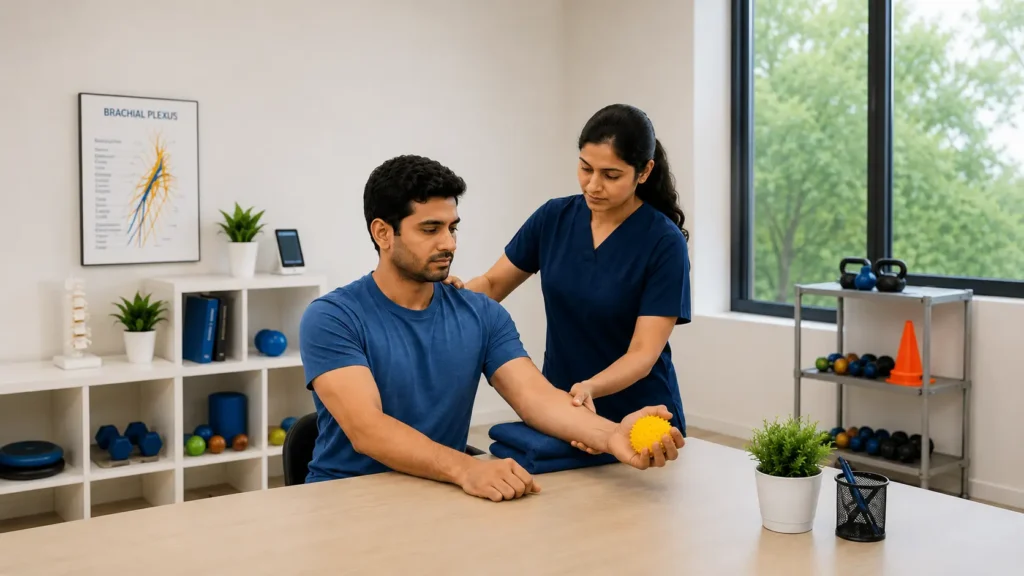
After a brachial plexus injury diagnosis in Hyderabad, families are typically directed toward physiotherapy. In many cases, general occupational therapy follows at some stage. What these families gradually discover is that the occupational therapy they are receiving is not specifically designed for a peripheral nerve injury. It is a general daily living skills programme applied to a condition that has very particular clinical demands: structured sensory re-education because the limb has lost its sensory feedback, mirror therapy because the motor cortex networks directing the affected arm need neuroplastic reorganisation, and bimanual retraining because restoring two-handed function is not a bonus goal but a clinical necessity for most patients.
A brachial plexus occupational therapy specialist Hyderabad with genuine expertise in peripheral nerve injury does not arrive at these interventions by accident. They are the result of condition-specific clinical training, experience with brachial plexus presentations across all severities, and a programme structure that is designed from the outset around the neuroscience of what this injury does to the arm, the hand, and the daily life of the person living with it.
Plexus at Banjara Hills, Hyderabad delivers occupational therapy treatment for brachial plexus Hyderabad through occupational therapy specialists with condition-specific expertise in peripheral nerve injury and upper limb rehabilitation, within a Regenerative Rehabilitation Programme that also provides autologous cell therapy and specialist physiotherapy. As Hyderabad’s only ISO-certified regenerative rehabilitation and research centre, under the clinical leadership of Dr. Na’eem Sadiq with over 35 years of neurological expertise and more than 500,000 patients treated, Plexus offers the most clinically comprehensive brachial plexus occupational therapy programme in the city.
What Brachial Plexus Injury Does to Daily Life in Hyderabad
Brachial plexus injury removes function from an upper limb that every daily task depends on. For Hyderabad patients, the functional consequences show up in every area of daily life, and they are the specific targets of occupational therapy at Plexus.
In Children with Brachial Plexus Birth Injuries
- Erb’s Palsy affects the upper brachial plexus roots C5 and C6, producing a shoulder that cannot raise the arm, an elbow that cannot flex independently, and a forearm fixed in pronation. The child is excluded from bimanual play, cannot bring the hand to the face for self-feeding, cannot reach above the horizontal, and misses the developmental upper limb milestones that peers are acquiring. As the child grows, the consequences extend into school participation: writing, scissors use, carrying a school bag, and every classroom activity that requires two functioning hands.
- Klumpke’s Palsy affects the lower brachial plexus roots C8 and T1, producing weakness or paralysis of the intrinsic hand muscles and wrist and finger flexors. The claw hand posture that results renders grip, pinch, and all fine motor hand function compromised or absent. For a child in Hyderabad, this means inability to hold a pencil, manipulate small objects, fasten clothing, or participate in the hand-dependent activities of daily school and home life.
- In Adults with Traumatic Brachial Plexus Injuries For working-age adults in Hyderabad, a traumatic brachial plexus injury most commonly sustained in a road traffic accident produces immediate and extensive daily functional loss. Dressing requires family assistance. Eating with utensils is compromised or impossible with the affected hand. Professional tasks requiring keyboard use, writing, or object handling cannot be performed as before. Personal hygiene becomes dependent. The social and psychological consequences of that level of daily dependence accumulate alongside the physical impairment itself.
These are not peripheral problems. They are the central clinical targets of occupational therapy for brachial plexus rehabilitation Hyderabad at Plexus.
Ready to Begin?
Our centres in Bengaluru (HRBR Layout) and Hyderabad are open Monday to Saturday, 8:30 AM to 6:30 PM.
What Occupational Therapy Involves for Brachial Plexus at Plexus Hyderabad
The Occupational Therapy Assessment
Occupational therapy at Plexus Hyderabad begins with a thorough functional assessment establishing the baseline for each individual patient’s programme:
- Functional independence mapping across every daily task the injury has impaired, distinguishing between tasks the patient can perform independently, those requiring compensation strategies, and those currently beyond functional capacity
- Hand function baseline covering grip strength, pinch strength, object handling, and bimanual coordination
- Sensory profile documenting the distribution and character of sensory loss across the affected limb, identifying tactile, proprioceptive, and discriminative sensation deficits
- For children, a developmental assessment covering bimanual play skills, age-appropriate upper limb milestones, and the specific functional gaps the brachial plexus birth injury has created at the child’s current stage of development
Muscle Re-education and Retraining Therapy
- Plexus’s occupational therapist for brachial plexus injury Hyderabad uses structured muscle re-education through purposeful, task-oriented activity to progressively rebuild voluntary motor control in the affected arm and hand. Activities are graded to the patient’s current innervation level and progressed systematically as motor recovery advances through the programme, with each activity chosen for both its therapeutic demand and its functional relevance to the patient’s daily life in Hyderabad.
Sensory Re-education Therapy
- Sensory loss is among the most consistently underaddressed dimensions of brachial plexus injury in general rehabilitation settings in Hyderabad. Without rebuilding sensory feedback in the affected limb, motor recovery cannot translate into reliable, effective daily hand use, because the hand cannot feel what it is holding, cannot judge the force it is applying, and cannot receive the continuous sensory information that safe and purposeful object manipulation requires.
- Plexus’s brachial plexus occupational therapy specialist Hyderabad delivers a structured sensory re-education programme that progresses systematically from basic tactile awareness through localisation training, texture discrimination, two-point discrimination, and proprioceptive retraining, advancing as the patient’s sensory recovery demonstrably improves through the course of the programme.
Mirror Therapy
- Mirror therapy is integrated within the occupational therapy programme at Plexus Hyderabad as a neuroplasticity-based tool for motor recovery support. A mirror positioned at the body’s midline creates the visual appearance of normal movement in the affected arm by reflecting the movement of the unaffected arm. This visual feedback activates motor cortex networks associated with the affected limb, supporting neuroplastic reorganisation of motor control pathways during peripheral nerve recovery.
- At Plexus Hyderabad, mirror therapy is delivered as part of the broader occupational therapy programme, coordinated with muscle re-education and sensory re-education to support central motor reorganisation alongside the peripheral nerve recovery that cell therapy and physiotherapy are facilitating.
Hand Function Training
- Hand function is the most practically significant domain of brachial plexus occupational therapy at Plexus Hyderabad, and it is approached with specificity:
- Grip and Object Holding: Progressive grip strength training from the patient’s current functional baseline to the level required for independence in daily holding and carrying tasks, across varied object sizes, weights, and textures encountered in daily Hyderabad life.
- Pinch and Precision Grip: Systematic development of the pinch and precision grip skills required for writing, button fastening, key use, utensil handling, and the fine motor tasks that personal independence and occupational function depend on.
- Bimanual Coordination Retraining: Structured two-handed task training to rebuild the capacity to use both hands together in daily activities from which the brachial plexus injury has excluded the affected hand, progressed from simple bilateral reaching tasks to complex coordinated bimanual activities as function improves.
- Task-Specific Functional Training: Hand and upper limb training centred on the daily activities and personal functional priorities most relevant to each individual patient’s life in Hyderabad, ensuring that motor and sensory gains translate into the specific independence improvements that matter most.
ADL Training
- ADL training at Plexus Hyderabad translates functional gains into practical daily independence for occupational therapist for brachial plexus rehabilitation Hyderabad patients:
- Dressing and Personal Grooming: Retraining of dressing and personal care using the affected limb at its current functional level, including strategies for clothing fasteners and grooming tasks, progressed as motor and sensory recovery advances.
- Meal Preparation and Eating: Utensil use retraining, one-handed and bimanual kitchen management, and eating skill restoration to address one of the most daily-felt functional consequences of brachial plexus injury in adult and older paediatric patients in Hyderabad.
- Writing and Professional Task Retraining: For Hyderabad patients with occupational or educational demands requiring written communication or keyboard use, structured retraining of the hand and upper limb function these tasks require.
- Household and Community Task Management: Graded activity retraining across the domestic and community tasks relevant to each patient’s daily life in Hyderabad.
Hand Splinting
- Plexus’s occupational therapy team in Hyderabad designs and provides individually fitted hand splints where structural support is required to maintain joint alignment, prevent contracture, and support functional hand positioning during recovery. Splints are reviewed and modified regularly as the patient’s functional status evolves through the programme.
Play Skill Retraining for Hyderabad Children
- For Hyderabad children with Erb’s Palsy, Klumpke’s Palsy, or combined brachial plexus birth injury presentations, Plexus’s occupational therapists deliver a developmentally grounded programme covering bimanual play skill development, reach and grasp retraining, object manipulation and tool use appropriate to the child’s age, and for school-age children, the writing, scissors use, and fine motor classroom skills that academic participation requires.
How Occupational Therapy Coordinates With the Full Programme at Plexus Hyderabad
Occupational therapy for brachial plexus injury at Plexus Hyderabad is not a standalone service. It is delivered as a coordinated component of the Regenerative Rehabilitation Programme alongside autologous cell therapy and specialist physiotherapy.
Cell therapy reduces the inflammatory environment surrounding the damaged nerves and releases neurotrophic factors supporting nerve fibre regeneration, creating a neurobiological context in which rehabilitation is more productive. Physiotherapy builds the motor and sensory foundations of upper limb recovery. Occupational therapy at Plexus Hyderabad takes those foundations and translates them into the practical daily function that defines real-world recovery for each patient.
Who Should Seek Brachial Plexus Occupational Therapy at Plexus Hyderabad
- Children in Hyderabad with Erb’s Palsy or Klumpke’s Palsy who have not received condition-specific occupational therapy that includes sensory re-education, mirror therapy, and bimanual retraining appropriate to their developmental stage
- Adults in Hyderabad with traumatic brachial plexus injury experiencing impaired independence in dressing, eating, writing, or personal care due to motor or sensory loss in the affected arm and hand
- Patients who have undergone surgical nerve repair and require structured post-operative occupational therapy to translate neurological recovery into functional daily independence
- Hyderabad families whose prior occupational therapy experience has not included the condition-specific interventions that brachial plexus injury demands and who are seeking a brachial plexus occupational therapy specialist Hyderabad with genuine peripheral nerve injury expertise
What Hyderabad Patients Have Experienced
Hyderabad patients completing occupational therapy for brachial plexus injury at Plexus have reported:
- Return of confident bimanual hand use in daily tasks from which the affected hand had previously been entirely excluded since the injury or from birth
- Improved grip and precision handling enabling independent eating, dressing, and object management that had previously required family assistance
- Progressive sensory recovery through the affected arm and hand via structured sensory re-education, with increasing tactile awareness enabling more reliable and effective voluntary hand use
- Greater daily independence across personal care, domestic tasks, and community participation in Hyderabad, with meaningful reduction in the assistance that families had been providing
- In children, active and spontaneous bimanual activity using the previously affected hand in play and school tasks, with developmental upper limb gains that prior therapy attempts had not produced
Why Plexus Offers Hyderabad’s Leading Occupational Therapy for Brachial Plexus Rehabilitation
Condition-Specific Expertise in Peripheral Nerve and Upper Limb Rehabilitation
- Plexus’s occupational therapy specialists in Hyderabad bring brachial plexus-specific clinical expertise, applying sensory re-education, mirror therapy, and bimanual retraining protocols grounded in the neurology of peripheral nerve injury, not general occupational therapy practice.
Coordinated With Cell Therapy and Physiotherapy in a Single Programme
- Occupational therapy at Plexus Hyderabad is delivered within a neurological context no standalone service in Hyderabad provides, coordinated with autologous cell therapy and specialist physiotherapy so that every discipline informs the others throughout recovery.
ISO-Certified Clinical Standards
- ISO certification at Plexus Hyderabad covers the complete clinical programme including occupational therapy assessment and treatment delivery, providing verified quality assurance at the Banjara Hills centre.
Over 70 National and International Awards for Clinical Excellence
- More than 70 awards for clinical excellence in neurological and regenerative rehabilitation reflect consistent outcomes for brachial plexus injury patients at Plexus across paediatric and adult presentations.
Other Neurological Conditions Treated at Plexus Hyderabad
Specialist programmes including occupational therapy are available for Cerebral Palsy, Multiple Sclerosis, Spinal Cord Injury, Parkinson’s Disease, Motor Neuron Disease, Stroke, Spinocerebellar Ataxia, and Autoimmune Neurological Conditions.
Ready to Begin?
Our centres in Bengaluru (HRBR Layout) and Hyderabad are open Monday to Saturday, 8:30 AM to 6:30 PM.
Source Transparency and Editorial Accountability
Supporting Evidence
- Chemnitz, A., Bjorkman, A., et al. (2013). Functional outcome thirty years after median and ulnar nerve repair in childhood and adolescence. Journal of Bone and Joint Surgery, 95(4), 329-337. (Source for long-term functional outcomes of upper limb peripheral nerve injury occupational therapy rehabilitation.)
- Pondaag, W., Malessy, M.J.A., et al. (2004). Natural history of obstetric brachial plexus palsy: a systematic review. Developmental Medicine and Child Neurology, 46(2), 138-144. (Source for Erb’s Palsy and Klumpke’s Palsy functional consequences and occupational therapy rehabilitation goals.)
- Yancosek, K.E., Howell, D. (2009). A narrative review of dexterity assessments. Journal of Hand Therapy, 22(3), 258-270. (Source for hand function training and occupational therapy outcome measurement in upper limb nerve injury.)
- Novak, I., et al. (2009). Mirror therapy in children with hemiplegia: a randomized controlled trial. Developmental Medicine and Child Neurology, 51(4), 271-278. (Source for mirror therapy neuroplasticity mechanisms and motor recovery outcomes in peripheral nerve injury contexts.)
- Indian Council of Medical Research (ICMR). Guidelines on Regenerative Medicine and Cell-Based Therapies. https://www.icmr.gov.in
- Plexus Clinical Programme Data, used for editorial validation. Plexus
Last Updated: May 2026
Frequently Asked Questions
What does a brachial plexus occupational therapist Hyderabad at Plexus focus on?
A brachial plexus occupational therapist at Plexus Hyderabad focuses on rebuilding practical daily independence through muscle re-education and retraining therapy, sensory re-education therapy, mirror therapy, hand function training covering grip, pinch, and bimanual coordination, ADL training, hand splinting, and developmentally grounded play skill retraining for children, all within a programme coordinated with cell therapy and physiotherapy.
How does this brachial plexus occupational therapy specialist Hyderabad differ from general occupational therapy in Hyderabad?
Plexus’s brachial plexus occupational therapy specialists in Hyderabad apply condition-specific peripheral nerve injury interventions including structured sensory re-education, mirror therapy, and bimanual retraining protocols that general occupational therapy in Hyderabad does not routinely include, within a programme coordinated with autologous cell therapy and specialist physiotherapy.
Is occupational therapy treatment for brachial plexus Hyderabad available for children with birth injuries at Plexus?
Yes. Plexus Hyderabad’s occupational therapy programme for brachial plexus injury is fully designed for children with Erb’s Palsy and Klumpke’s Palsy, covering bimanual retraining, play skill development, hand function training, sensory re-education, and splinting where required.
Can an occupational therapist for brachial plexus rehabilitation Hyderabad at Plexus help after nerve surgery?
Yes. Plexus’s occupational therapy specialists in Hyderabad provide structured post-operative rehabilitation following surgical nerve repair, translating neurological recovery into functional daily independence gains across dressing, eating, writing, and personal care.
Where in Hyderabad is the brachial plexus occupational therapist at Plexus located?
Occupational therapy for brachial plexus injury is available at Plexus’s Banjara Hills centre in Hyderabad, open Monday to Saturday from 8:30 AM to 6:30 PM. Appointments can be booked at Plexus.