
Reviewed by Dr. Na’eem Sadiq, Senior Neurologist | Plexus Neuro and Cell Therapy Centre, Bengaluru and Hyderabad | June 2026
Quick Answer
Caring for a parent with Parkinson’s disease at home provides essential emotional continuity and daily support. However, the physical, cognitive and psychological dimensions of Parkinson’s disease often require specialist rehabilitation support that family caregiving cannot provide alone. Home care provides essential daily support. Specialist rehabilitation works toward preserving safety, independence, communication and confidence for as long as possible.
Specialist rehabilitation at Plexus adds physiotherapy, occupational therapy, speech and language therapy, cognitive rehabilitation, and where appropriate, carefully selected cell therapy as part of a coordinated programme. The clinical team also actively trains family caregivers in home exercise programmes, handling techniques, and strategies to support daily activities safely.
The Regenerative Rehabilitation Programme at Plexus Neuro and Cell Therapy Centre in Bengaluru and Hyderabad supports both the parent and the family through every stage of Parkinson’s disease.
Key Takeaways
- Home care provides essential emotional support but cannot replace clinical rehabilitation. The physical and cognitive dimensions of Parkinson’s disease require specialist intervention.
- Common signs that home care is reaching its limits include falls, increasing confusion, medication management difficulties, and growing caregiver fatigue.
- Specialist rehabilitation addresses motor function, daily independence, speech and swallowing, cognition, and psychological wellbeing as a coordinated programme.
- Cell therapy at Plexus may be considered only for carefully selected patients after detailed assessment. It uses autologous mesenchymal cells from the patient’s own bone marrow and is not offered as a stand-alone treatment or cure.
- Caregiver education is a structured part of every Plexus programme. Family members are taught the home exercise programme, handling techniques, and how to support safe daily activities.
- Seeking specialist support is not a sign of failure. It is the decision that most benefits both the parent and the person caring for them.
- The clinical team at Plexus provides guidance on the programme, answers family questions, and adapts the plan continuously as the parent’s needs change
Speak to Our Team About Your Parent’s
Our specialist team in Bengaluru (HRBR Layout) and Hyderabad provides free consultations for Parkinson’s disease rehabilitation.
Introduction
“I have been looking after my father for two years. I manage his medications, his meals, his appointments, and the difficult hours when the medication is not working. I do everything I can. But watching his condition worsen, and not knowing how to help with the clinical side of it, is exhausting. I feel like I am failing him.”
Adult children caring for a parent with Parkinson’s disease are not failing. They are doing something that has genuine limits, and recognising those limits is the most important step they can take for their parent’s care. Home care, however dedicated, is not designed to replace specialist assessment by a physiotherapist, occupational therapist, speech therapist or rehabilitation physician.
Parkinson’s disease progresses. The physical demands of caring for a parent with the condition increase over time. Without specialist rehabilitation working alongside home care, risks such as falls, deconditioning, swallowing difficulty, unsafe medication routines and caregiver strain may go unaddressed.
This guide is written for adult children and family carers. It explains what Parkinson’s disease does to a parent over time, how to recognise when home care is reaching its limits, and what the specialist rehabilitation programme at Plexus in Bengaluru and Hyderabad adds that home care cannot provide.
What Parkinson’s Disease Does to Your Parent Over Time
The physical progression
In the early stages, Parkinson’s disease produces tremor, mild stiffness, and slowed movement that medication typically manages reasonably well. Over time, the condition progresses. Walking becomes more effortful and less safe. Balance deteriorates. Medication provides shorter periods of good control, and symptoms return predictably before the next dose is due.
The physical demands of daily life increase for a parent with advanced Parkinson’s disease: getting up from a chair, turning safely, navigating bathroom activities, dressing, and preparing food all become progressively more difficult. Family carers often absorb these demands gradually, without recognising how much their caregiving role has grown.
Non-motor changes that are hardest to manage at home
The non-motor features of Parkinson’s disease are often more disruptive to daily life than the motor symptoms and are frequently more difficult for family carers to understand and manage:
- Cognitive changes: slowing of thinking, word-finding difficulties, reduced ability to plan and complete multi-step tasks such as managing medications or cooking safely.
- Sleep disturbances: vivid dreams, frequent night waking, and restless legs that affect both the parent and family members in the same home.
- Depression and anxiety: persistent low mood, loss of motivation, and anxiety about falling or being seen in public. These may present as withdrawal or irritability rather than expressed sadness.
- Speech and swallowing changes: a quieter voice, less distinct speech, and increasing difficulty with certain foods and liquids that may progress more rapidly than a parent acknowledges.
- Behavioural changes during sleep: acting out dreams, calling out, or moving during sleep, which can be distressing for family members to witness.
Signs That Home Care Is No Longer Sufficient
Physical warning signs
- Your parent has fallen, even once. A first fall in Parkinson’s disease is a clinical signal that warrants immediate specialist physiotherapy assessment.
- Getting up from a chair, the toilet, or the bed has become unsafe to do without a person nearby.
- Your parent is holding onto furniture or walls to walk in familiar indoor environments.
- Medication is being managed inconsistently: doses are missed, doubled, or taken at the wrong time.
- Meals are taking significantly longer and your parent is eating less because swallowing has become effortful.
- Personal hygiene is becoming harder to maintain because dressing, bathing or toileting has become physically difficult or unsafe to manage alone.
Cognitive and emotional warning signs
- Your parent is becoming confused about familiar routines or struggling to follow conversations.
- Safety incidents are increasing: forgetting the stove, mismanaging medications, or becoming disoriented in familiar surroundings.
- Your parent has stopped engaging with previously valued activities and spends most of the day inactive.
- Nighttime disturbances are frequent enough to significantly affect the sleep of other household members.
- You are reducing your work commitments or personal time regularly to respond to care needs that were previously manageable.
Dr. Na’eem Sadiq notes: The point at which home care becomes insufficient is rarely a single moment. It is a gradual accumulation of demands that each feel manageable individually but together exceed what one family can safely provide. Seeking specialist rehabilitation support is not an admission of failure. It is often the decision that best supports both the person with Parkinson’s disease and the family caring for them.
If several of these signs apply to your parent, our team in Bengaluru or Hyderabad can assess the current clinical picture and explain what the programme works toward. Book a free consultation.
The Cost of Caregiving Without Specialist Support
Caregiver exhaustion and its effect on care quality
- Caregiver exhaustion, the physical, emotional, and mental depletion that results from sustained caregiving without adequate support, is very common among family members of people with advancing Parkinson’s disease. A carer who is exhausted, anxious and without respite may find it harder to respond patiently to their parent’s behavioural and cognitive changes, less consistent in supporting the daily activities and exercises that slow physical decline, and more likely to make decisions under crisis conditions rather than from a considered clinical plan.
When home care inadvertently slows a parent’s progress
- With the best intentions, family carers often complete tasks for a parent rather than supporting the parent to do them independently. This is faster and avoids frustration in the moment. But it progressively removes the physical and cognitive activity that slows the functional decline of Parkinson’s disease. A parent who is assisted with everything has fewer opportunities to practise and maintain the skills that rehabilitation aims to build. Specialist rehabilitation provides structured, clinically calibrated activity that home care, without guidance, cannot consistently replicate.
What Specialist Rehabilitation at Plexus Adds
The Regenerative Rehabilitation Programme at Plexus Neuro and Cell Therapy Centre provides clinical components of Parkinson’s disease management that home care cannot deliver alone. All therapies are delivered by a coordinated specialist team under the supervision of Dr. Na’eem Sadiq.
Physiotherapy
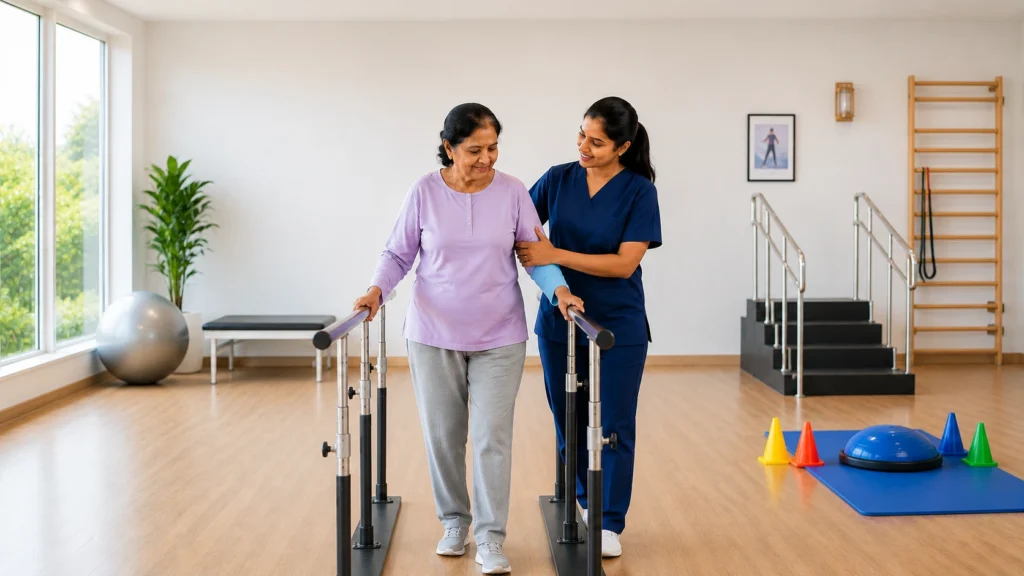
- Physiotherapy at Plexus delivers structured, progressively advancing exercise and movement rehabilitation that home exercise alone cannot replicate. The programme assesses and addresses your parent’s specific gait, balance, and strength profile. The physiotherapy team also teaches a structured home exercise programme that you, as a carer, can support between clinic sessions.
Occupational Therapy
- Occupational therapy at Plexus works with both the patient and the family to build practical strategies that maintain independence in daily activities and reduce the daily care burden. The OT team assesses your parent’s home environment, recommends modifications and equipment to reduce fall risk and effort, and teaches both the patient and the carer the most effective techniques for managing dressing, bathing, eating, and daily routines.
Speech and Language Therapy
- Speech and language therapy at Plexus addresses the voice and swallowing changes that family carers often notice but do not know how to support. The programme works toward maintaining communication effectiveness and safer swallowing and clearer communication for as long as possible. The therapist advises family members on effective strategies for supporting communication when a parent’s voice has become quieter or less distinct.
Cognitive Rehabilitation
- Cognitive rehabilitation at Plexus addresses the attention, memory, executive function, and processing speed changes that accumulate in Parkinson’s disease. The programme builds practical strategies and compensatory skills that reduce the impact of cognitive changes on daily safety and independence, and equips caregivers with tools to support their parent at home.
Cell Therapy
At Plexus, autologous mesenchymal cell therapy may be considered only for carefully selected patients after detailed neurological assessment. It uses the patient’s own cells and may be offered, where appropriate, as part of an integrated regenerative rehabilitation programme.
This approach is distinct from embryonic or donor/allogeneic stem-cell interventions. Cell therapy is not a stand-alone treatment, not a cure, and not suitable for every patient. Suitability, risks and expected outcomes are discussed individually with the clinical team before any recommendation is made.
Caregiver Education as Part of the Programme
A specific and structured component of every Plexus programme is education for family carers. The physiotherapy and occupational therapy teams dedicate clinic time to teaching carers the home exercise programme, safe handling and positioning techniques, how to recognise warning signs, and how to support daily activities in a way that encourages the parent’s own effort rather than replacing it. Carers who participate actively in the programme may feel more confident, less anxious and better equipped to provide daily support.
What the Specialist Rehabilitation Programme Works Toward
Specialist rehabilitation at Plexus does not replace home care. It gives home care the clinical foundation it needs to be effective. For your parent, it means a structured, advancing programme of therapy that addresses every dimension of their Parkinson’s disease under the care of specialists. For you, it means the clinical team is available to answer difficult questions, adjust the plan as your parent’s needs change, and share responsibility for the clinical management of the condition.
Many families who bring a parent to Plexus report that the decision was delayed longer than it should have been, often because home care felt like something they should manage themselves. The earlier specialist rehabilitation is integrated into a parent’s care plan, the more the programme can work toward.
Enquire About the Plexus Programme for Your Parent
Our specialist team in Bengaluru and Hyderabad can assess your parent’s current needs and explain how the programme integrates with home care.
Why Choose Plexus for Parkinson’s Disease Rehabilitation
- Neurologist-led, ISO-certified programme: Plexus is India’s first ISO-certified centre for regenerative rehabilitation.
- Integrated multidisciplinary delivery: All therapies are delivered as one coordinated programme under a single clinical team. Patients are not referred between separate providers.
- Cell therapy for carefully selected patients: Autologous mesenchymal cell therapy is offered only to carefully evaluated patients and is always delivered alongside physiotherapy and occupational therapy. It is not a standalone treatment.
- LSVT LOUD and LSVT BIG certified: Plexus therapists are certified in LSVT LOUD (voice) and LSVT BIG (movement), two of the most evidence-supported protocols for Parkinson’s disease rehabilitation.
- Personalised and continuously reviewed: Every programme is built around the patient’s specific symptoms, disease stage, and daily life goals. Plans are reviewed and updated as the condition progresses.
- Caregiver education integrated: Family members and caregivers are actively trained in home exercise programmes, handling techniques, and early warning sign recognition as part of every clinical programme.
- Virtual consultations available: Virtual consultations are available for patients who are unable to travel to the Bengaluru or Hyderabad centres.
About Plexus Neuro and Cell Therapy Centre
Plexus Neuro and Cell Therapy Centre operates ISO-certified rehabilitation centres in Bengaluru (HRBR Layout) and Hyderabad. The programme is led by Dr. Na’eem Sadiq, founder and Chief Neurologist, with over 35 years of specialised experience in neurological and regenerative rehabilitation.
- More than 500,000 patients treated across the Bengaluru and Hyderabad centres
- More than 70 national and international awards for clinical excellence in neurological rehabilitation, including recognition from Fortune India
- Internationally published research in Multiple Sclerosis, Epilepsy, Migraine, and Demyelinating Polyneuropathy
- Specialist outpatient services covering neurology, neuropsychiatric disorders, pain, stroke, cerebral palsy, epilepsy, geriatric care and sports medicine
- Comprehensive therapy services including physiotherapy, occupational therapy, speech and language therapy, cognitive rehabilitation, aquatic therapy, behaviour therapy, and swallowing therapy
- Regenerative Rehabilitation Programme for neurological conditions including Parkinson’s disease, stroke, multiple sclerosis, spinal cord injury, brachial plexus injury, cerebral palsy, and motor neuron disease.
- Centres open Monday to Saturday, 8:30 AM to 6:30 PM, in Bengaluru and Hyderabad
Ready to Begin?
Our centres in Bengaluru (HRBR Layout) and Hyderabad are open Monday to Saturday, 8:30 AM to 6:30 PM.
Research and Evidence
The following peer-reviewed studies and clinical guidelines inform the rehabilitation approaches described in this blog.
- Bloem BR et al. Integrated multidisciplinary care for patients with Parkinson’s disease: a systematic review and meta-analysis. Lancet Neurology. 2020;19(9):753-762. https://doi.org/10.1016/S1474-4422(20)30064-9
- Osborne JA et al. Physical Therapist Management of Parkinson Disease: A Clinical Practice Guideline. Physical Therapy. 2022;102(4):pzab302. https://doi.org/10.1093/ptj/pzab302
- Greenland JC, Williams-Gray CH, Barker RA. The clinical heterogeneity of Parkinson’s disease and its therapeutic implications. European Journal of Neuroscience. 2019;49(3):328-338. https://pubmed.ncbi.nlm.nih.gov/29920837/
- Schrag A. Psychiatric aspects of Parkinson’s disease: an update. Journal of Neurology. 2004;251(7):795-804. https://pubmed.ncbi.nlm.nih.gov/15258803/
- Bello-Haas VD et al. Rehabilitation for individuals with Parkinson disease. Physical Therapy. 2018;98(8):657-670. https://pubmed.ncbi.nlm.nih.gov/29579256/
Frequently Asked Questions
At what point should I seek specialist rehabilitation for my parent with Parkinson’s disease?
Specialist rehabilitation benefits people with Parkinson’s disease at every stage, but the earlier it begins, the more it can work toward. Key signals include falls or near-falls, worsening balance, increasing difficulty with daily activities, speech or swallowing changes, medication management difficulties, and growing caregiver fatigue. If you are asking this question, it is likely the right time.
How is specialist physiotherapy different from home exercises for Parkinson’s disease?
Specialist physiotherapy at Plexus provides a clinically assessed, progressively structured programme that is adapted at every review to the parent’s current clinical status. Home exercises provide useful maintenance between sessions but cannot deliver the systematic assessment, clinical progression, or individual adjustment that specialist physiotherapy provides.
Will the Plexus team teach me how to help my parent at home?
Yes. Caregiver education is a structured part of every Plexus programme. The physiotherapy and occupational therapy teams teach carers the home exercise programme, safe handling and positioning techniques, early warning sign recognition, and daily care strategies that support the parent’s own effort and independence.
How do I know when home care is no longer enough for my parent with Parkinson’s disease?
Key indicators include falls at home, unsafe medication management, significant swallowing or eating difficulties, withdrawal from daily activities, nighttime disturbances affecting household members, and your own increasing difficulty managing care demands. Any of these warrants a specialist assessment at Plexus.
Does Plexus support both the patient and the family carer?
Yes. The Plexus programme explicitly involves family carers in the rehabilitation process through structured carer education, home programme teaching, and guidance on daily care strategies. The clinical team is available to answer questions and advise on adapting the home care approach as your parent’s needs evolve.
What if my parent lives far from Bengaluru or Hyderabad?
Plexus offers virtual consultations for patients who cannot travel to the Bengaluru (HRBR Layout) or Hyderabad centres. The clinical team can conduct an initial assessment, discuss possible care options and advise on home management strategies remotely before a decision about in-person attendance is made.
Medical Disclaimer: This blog is intended for general educational purposes and does not constitute medical advice. Parkinson’s disease affects each person differently and all treatment decisions should be made by a qualified neurologist or rehabilitation specialist following thorough clinical assessment. Cell therapy is offered only to suitable, carefully evaluated patients and outcomes vary between individuals. Always consult your medical team before making changes to your treatment plan.