
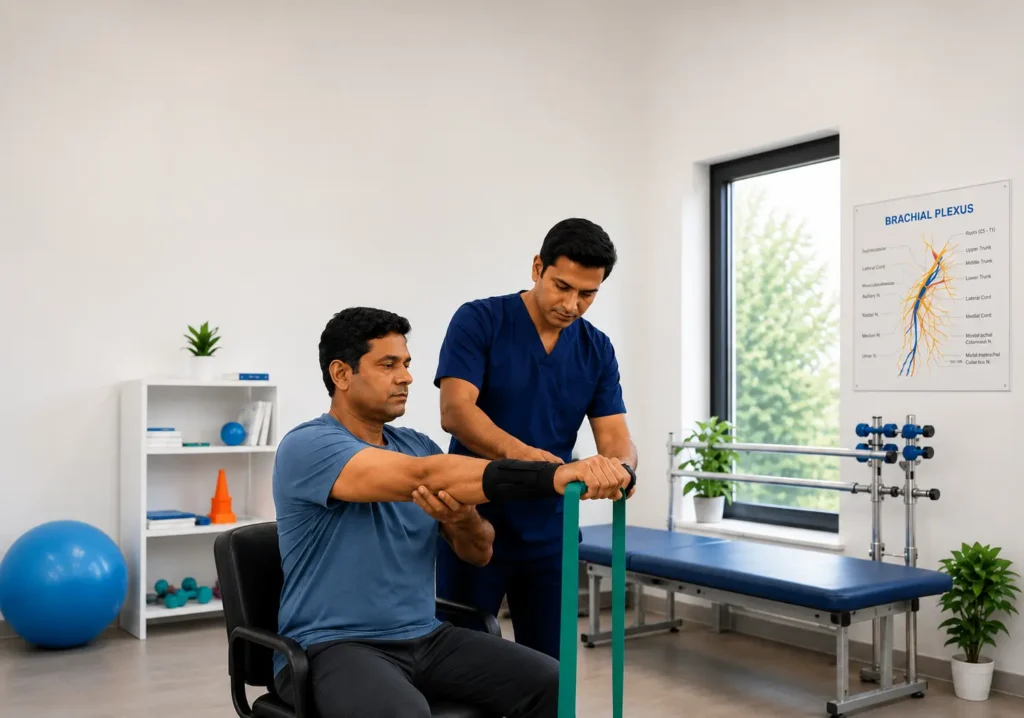
The Part of Brachial Plexus Recovery That Most Centres Miss
When a brachial plexus injury reduces or removes function in an arm, the immediate medical focus falls on the nerve damage. Neurology assessments, imaging, physiotherapy referrals, discussions about surgical options. All of that is necessary and important.
What frequently receives insufficient attention is the part of recovery that families feel most acutely in daily life: the inability to dress, to cook, to eat independently, to write, to manage personal care, to use both hands together for the two-handed tasks that daily life is built on. These are not physiotherapy goals. They are occupational therapy goals. And they require a brachial plexus occupational therapy specialist India who understands not just general daily living skills, but the specific neurology of peripheral nerve injury and the particular functional consequences that brachial plexus damage produces in the arm and hand.
Plexus, India’s first ISO-certified regenerative rehabilitation and research centre, delivers occupational therapy treatment for brachial plexus India through a team of specialists with condition-specific expertise in peripheral nerve injury and upper limb rehabilitation. Founded by Dr. Na’eem Sadiq with over 35 years of neurological expertise and more than 500,000 patients treated, Plexus integrates occupational therapy for brachial plexus injury within a Regenerative Rehabilitation Programme that also provides autologous cell therapy and specialist physiotherapy, at ISO-certified centres in Bangalore and Hyderabad.
Why Occupational Therapy Is Clinically Indispensable in Brachial Plexus Injury
A brachial plexus injury does not only damage a nerve network. It removes function from an arm that a person uses for virtually every task in their daily life. For an adult, that may mean the inability to button a shirt, use a fork, type, write, or manage personal hygiene independently. For a child, it may mean exclusion from bimanual play, difficulty at school, and the developmental consequences of not acquiring the two-handed upper limb skills that the unaffected peer group takes for granted.
Physiotherapy addresses the motor and sensory foundation of recovery: strength, range of motion, sensory tone, neuromuscular re-education. Occupational therapy builds on that foundation to restore the practical daily function and independence that the injury has removed. Neither is sufficient without the other. Together, as part of Plexus’s coordinated programme, they produce outcomes that neither discipline achieves in isolation.
An occupational therapist for brachial plexus injury India at Plexus does not apply a generic daily living skills programme to a patient with a peripheral nerve injury. They apply a condition-specific programme designed around the precise functional deficits that brachial plexus injury produces, informed by the sensory and motor recovery profile of each individual patient, and coordinated with the cell therapy and physiotherapy components of the programme.
Ready to Begin?
Our centres in Bengaluru (HRBR Layout) and Hyderabad are open Monday to Saturday, 8:30 AM to 6:30 PM.
What Occupational Therapy for Brachial Plexus Involves at Plexus India
The Occupational Therapy Assessment
The occupational therapy component of Plexus’s brachial plexus programme begins with a detailed functional assessment that establishes the baseline from which the individual programme is designed:
- Functional independence evaluation covering the specific daily tasks the injury has impaired, identifying which activities the patient can perform independently, which require compensation strategies, and which are currently beyond the patient’s functional capacity
- Hand function baseline assessment documenting grip strength, pinch strength, fine motor coordination, and bimanual task capability
- Sensory profile assessment identifying the distribution and nature of sensory loss in the affected limb, distinguishing between tactile, proprioceptive, and discriminative sensation deficits
- For children, a developmental assessment of bimanual play skills, age-appropriate upper limb milestones, and the functional gaps the brachial plexus injury has created at the child’s current developmental stage
Muscle Re-education and Retraining Therapy
- Where motor function in the affected arm, hand, or shoulder has been reduced or lost due to the nerve injury, Plexus’s occupational therapists for brachial plexus injury India use structured muscle re-education techniques to progressively rebuild voluntary motor control through purposeful, task-oriented activity.
- The approach is graded carefully to the patient’s current level of innervation and motor recovery at each stage of the programme. Activities are selected for their functional relevance as well as their therapeutic demand, ensuring that motor retraining produces improvements that translate directly into the daily tasks the patient needs to perform.
Sensory Re-education Therapy
- Sensory loss is a consistent and clinically significant feature of brachial plexus injury that many general occupational therapy services underaddress. The affected limb loses not only motor function but the tactile, proprioceptive, and discriminative sensation that effective voluntary hand use depends on. Without rebuilding these sensory foundations, motor recovery cannot translate into reliable and effective daily function.
- Plexus’s brachial plexus occupational therapy specialist India delivers structured sensory re-education therapy that progresses systematically from basic tactile awareness through to fine discriminative sensation, rebuilding the sensory processing capacity of the affected arm and hand in a staged programme designed around each patient’s current sensory profile.
- The sensory re-education programme at Plexus includes localisation training, texture discrimination, two-point discrimination work, and proprioceptive retraining, progressing as nerve recovery allows and as the patient’s sensory awareness demonstrably improves through the programme.
Mirror Therapy
- Mirror therapy is a neuroplasticity-based intervention integrated within Plexus’s occupational therapy for brachial plexus rehabilitation India. The technique uses a mirror positioned at the body’s midline to create a visual representation of normal movement in the affected limb, using the reflection of the unaffected arm.
- The neurological mechanism underlying mirror therapy involves the activation of motor cortex networks associated with the affected limb through visual feedback, using the same motor planning pathways that direct upper limb movement. This central motor cortex activation supports the reorganisation of motor control networks during peripheral nerve recovery, and the published evidence base for mirror therapy in peripheral nerve injury and upper limb rehabilitation supports its inclusion in the occupational therapy programme.
Hand Function Training
- Hand function is the most functionally significant domain of brachial plexus occupational therapy at Plexus, and it is addressed with specificity and depth:
- Grip Strength Training: Progressive strengthening of the grip to restore functional object holding capacity across varied object sizes, weights, and textures, including the sustained grip required for daily activities such as carrying bags, holding a cup, or stabilising an object during a two-handed task.
- Pinch and Precision Grip: Development of the pinch and precision grip required for fine motor tasks including writing, button fastening, key use, handling coins, and the range of precision hand skills that daily independence depends on.
- Bimanual Coordination: Structured training of the capacity to use both hands together in the two-handed tasks from which a brachial plexus injury may have excluded the affected hand entirely, including food preparation, dressing, and the wide range of activities that require simultaneous bilateral upper limb function.
- Task-Specific Functional Training: Training designed around the specific functional goals that matter most to each individual patient, based on their personal daily activities, occupational demands, and the particular hand and arm skills their injury has most significantly disrupted.
ADL Training
- Activities of daily living training at Plexus translates motor and sensory gains into practical independence that makes a genuine difference in daily life for occupational therapist for brachial plexus rehabilitation India patients:
- Dressing and Personal Care: Strategies and retraining for managing clothing fasteners, garment management, grooming, and personal hygiene with the affected limb at its current functional level, progressed as motor and sensory recovery advances through the programme.
- Meal Preparation and Eating: Utensil use, safe kitchen management with a partially functional upper limb, food preparation tasks that require bimanual coordination, and eating strategies that restore independence and dignity at mealtimes.
- Writing and Communication: For patients whose brachial plexus injury has impaired their ability to write or use a keyboard, structured retraining of the hand and arm function required for written communication, alongside compensatory strategy training where motor recovery has not yet reached the level required.
- Household and Community Task Management: Activity adaptation and graded retraining for the full range of domestic and community tasks that the patient’s daily life requires, designed around each individual’s home and social environment.
Hand Splinting
- Hand splinting is an integral component of Plexus’s occupational therapy treatment for brachial plexus India. Individually designed splints are provided to maintain joint alignment, prevent contracture development, and support functional hand positioning during the recovery period.
- Splints are designed by Plexus’s occupational therapy team based on each patient’s injury pattern, current motor and sensory status, and functional requirements. They are reviewed and modified regularly as the patient’s recovery progresses, ensuring that structural support consistently reflects and facilitates the evolving rehabilitation goals.
How Occupational Therapy Fits Within Plexus’s Integrated Programme
Occupational therapy for brachial plexus injury at Plexus India does not operate in clinical isolation. It is delivered as a coordinated component of the Regenerative Rehabilitation Programme, alongside autologous cell therapy and specialist physiotherapy.
As cell therapy supports the biological environment of the recovering brachial plexus nerves, reducing inflammation and releasing neurotrophic factors that sustain nerve fibre regeneration, the occupational therapy programme is delivered against a limb that is neurologically supported rather than continuing to deteriorate. Physiotherapy builds the motor and sensory foundations of recovery. Occupational therapy translates those foundations into the daily functional independence that constitutes real-world recovery for each patient.
This three-component coordination is what distinguishes an occupational therapist for brachial plexus injury India at Plexus from a standalone occupational therapy service that delivers hand therapy without neurobiological context and without the motor recovery foundation that physiotherapy establishes.
Who Should Seek Occupational Therapy at Plexus for Brachial Plexus Injury India
- Children with Erb’s Palsy or Klumpke’s Palsy who have not yet received condition-specific occupational therapy targeting sensory re-education, bimanual retraining, and play skill development appropriate to their developmental stage
- Adults with traumatic brachial plexus injury experiencing impaired independence in dressing, eating, writing, personal care, or other daily activities due to motor or sensory loss in the affected limb
- Patients who have completed surgical nerve repair and require structured post-operative occupational therapy to translate neurological recovery into functional daily gains
- Patients whose prior general occupational therapy has not included sensory re-education, mirror therapy, or the condition-specific hand function and bimanual retraining that brachial plexus injury rehabilitation requires
What Patients Have Experienced Through Brachial Plexus Occupational Therapy at Plexus
Patients who have completed occupational therapy treatment for brachial plexus India at Plexus have reported:
- Return of bimanual function and the ability to use both hands together in daily tasks from which the affected hand had previously been entirely excluded
- Improved grip strength and precision handling, enabling independent eating, writing, dressing, and object management that had required family assistance since the injury
- Progressive return of sensation through the arm and hand via sensory re-education, with patients describing increasing tactile awareness that made purposeful voluntary hand use more reliable and more effective
- Greater independence across daily personal care, domestic activities, and community participation, with families reporting meaningful reduction in the daily assistance previously required
- In children, spontaneous and confident bimanual activity using the previously affected hand, with developmental upper limb skill gains that no prior therapy attempt had produced
Why Plexus Offers India’s Leading Occupational Therapy for Brachial Plexus Injury
Condition-Specific Expertise, Not General Occupational Therapy
- Plexus’s occupational therapy specialists bring brachial plexus-specific expertise in peripheral nerve injury and upper limb rehabilitation. The therapeutic approaches, the sequencing of interventions, and the integration of sensory re-education, mirror therapy, and bimanual retraining are all grounded in the specific neurology of brachial plexus injury, not general occupational therapy practice.
Integration With Cell Therapy and Physiotherapy
- Occupational therapy at Plexus is delivered within a neurological context that no standalone occupational therapy service provides. Coordinated with autologous cell therapy and physiotherapy within a single programme, every discipline informs and amplifies the others throughout the patient’s treatment.
ISO-Certified Clinical Standards
- ISO certification at Plexus covers the complete clinical programme structure including occupational therapy assessment, treatment delivery, and outcome monitoring, providing independently verified quality standards across Bangalore and Hyderabad centres.
Over 70 National and International Awards for Clinical Excellence
- More than 70 awards for clinical excellence in neurological and regenerative rehabilitation reflect sustained outcomes for brachial plexus injury patients, including those for whom occupational therapy and hand function rehabilitation are primary clinical goals.
Other Neurological Conditions Treated at Plexus
Specialist programmes including occupational therapy are available for Cerebral Palsy, Multiple Sclerosis, Spinal Cord Injury, Parkinson’s Disease, Motor Neuron Disease, Stroke, Spinocerebellar Ataxia, and Autoimmune Neurological Conditions.
Ready to Begin?
Our centres in Bengaluru (HRBR Layout) and Hyderabad are open Monday to Saturday, 8:30 AM to 6:30 PM.
Source Transparency and Editorial Accountability
Supporting Evidence
- Chemnitz, A., Bjorkman, A., et al. (2013). Functional outcome thirty years after median and ulnar nerve repair in childhood and adolescence. Journal of Bone and Joint Surgery, 95(4), 329-337. (Source for long-term functional outcomes of upper limb peripheral nerve injury rehabilitation including sensory and motor recovery trajectories.)
- Pondaag, W., Malessy, M.J.A., et al. (2004). Natural history of obstetric brachial plexus palsy: a systematic review. Developmental Medicine and Child Neurology, 46(2), 138-144. (Source for functional deficits, ADL implications, and rehabilitation goals in brachial plexus birth injury.)
- Yancosek, K.E., Howell, D. (2009). A narrative review of dexterity assessments. Journal of Hand Therapy, 22(3), 258-270. (Source for hand function training and occupational therapy outcome measurement in upper limb nerve injury.)
- Novak, I., et al. (2009). Mirror therapy in children with hemiplegia: a randomized controlled trial. Developmental Medicine and Child Neurology, 51(4), 271-278. (Source for mirror therapy neuroplasticity mechanisms and motor recovery outcomes in peripheral nerve injury and upper limb rehabilitation contexts.)
- Indian Council of Medical Research (ICMR). Guidelines on Regenerative Medicine and Cell-Based Therapies. https://www.icmr.gov.in
- Plexus Clinical Programme Data, used for editorial validation. Plexus
Last Updated: May 2026
Frequently Asked Questions
What does a brachial plexus occupational therapist India at Plexus focus on?
An occupational therapist for brachial plexus injury India at Plexus focuses on rebuilding practical daily independence through muscle re-education and retraining therapy, sensory re-education therapy, mirror therapy, hand function training covering grip, pinch, and bimanual coordination, ADL training, hand splinting, and for children, play skill retraining, all delivered by specialists with condition-specific expertise in peripheral nerve injury and upper limb rehabilitation.
How does a brachial plexus occupational therapy specialist India at Plexus differ from a general occupational therapist?
Plexus’s brachial plexus occupational therapy specialists apply condition-specific interventions designed around the neurology of peripheral nerve injury, including structured sensory re-education, mirror therapy, and bimanual retraining protocols that general occupational therapists do not routinely provide, within a programme coordinated with autologous cell therapy and physiotherapy.
Is occupational therapy treatment for brachial plexus India available for both children and adults at Plexus?
Yes. Plexus delivers occupational therapy for brachial plexus injury across all patient groups, from infants and children with Erb’s Palsy and Klumpke’s Palsy through to adults with traumatic brachial plexus injuries, with every programme individually designed following a thorough multi-domain assessment.
Can an occupational therapist for brachial plexus rehabilitation India at Plexus help after surgical nerve repair?
Yes. Plexus’s occupational therapy specialists work with patients post-operatively following surgical nerve repair, providing structured rehabilitation to translate the neurological recovery produced by surgery into measurable functional independence gains in daily life.
Is brachial plexus occupational therapy at Plexus available at both India centres?
Yes. Occupational therapy for brachial plexus injury is available at Plexus’s HRBR Layout in Bangalore, and at the Banjara Hills centre in Hyderabad, open Monday to Saturday from 8:30 AM to 6:30 PM. Appointments can be booked at Plexus .